
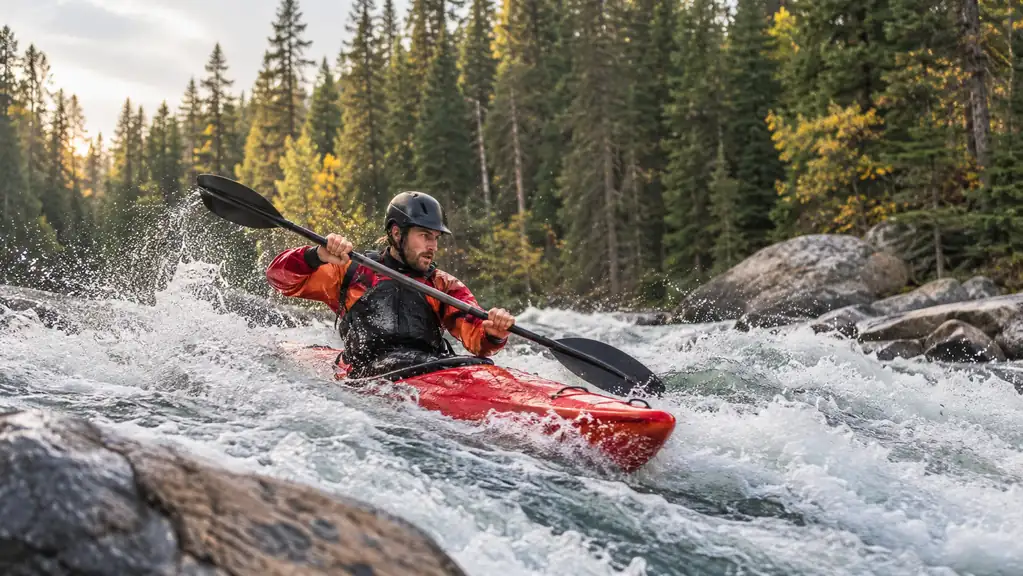
The Ocoee in April runs cold, and the first thing that happens when you swim is a spike of cold water straight into your ears that makes your whole head ring. I have taught weekend beginner clinics on that river for years. I have watched strong swimmers come up from a short, unremarkable swim looking stunned, not because they struck anything, but because the water hit them and their head did not like it.
That is usually where the helmet conversation starts. Not with a dramatic rock strike. With a small, ordinary thing that goes wrong on a river day and a piece of gear that was sitting in the truck. The Vihir adult water sports adjustable helmet is what a good number of my students show up wearing, and it is what I wear on class II and III days. Here are ten reasons I put one on for every run, including the short ones I have paddled a hundred times.
The helmet that stays on from put-in to take-out
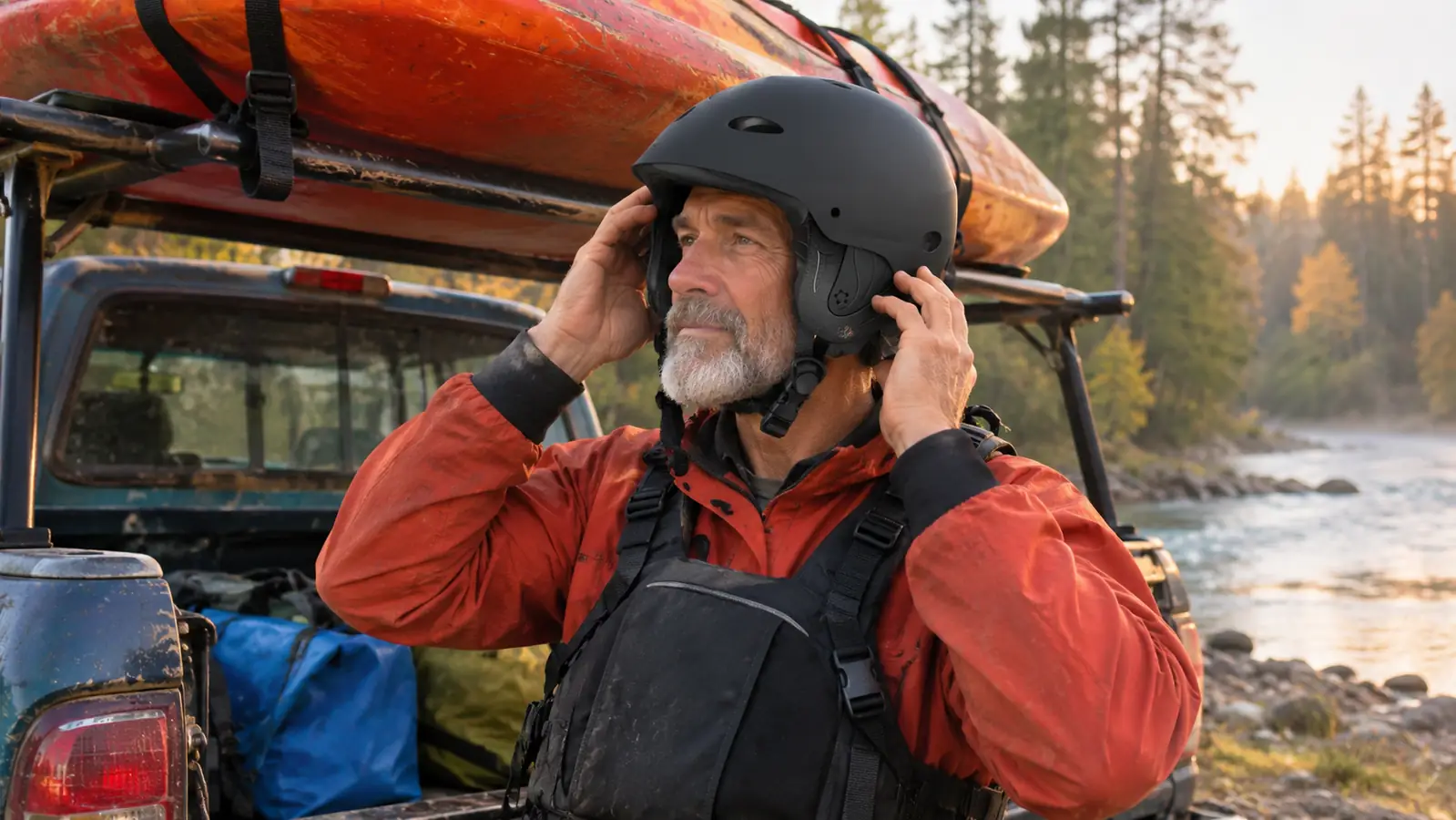
Vihir adult water sports adjustable helmet in size L, listed for 59 to 63 cm, with ear coverage, 11 vents and a one-year warranty. This is what I wear for class II and III days and every beginner clinic I teach.
Amazon Check Today's Price on Amazon →Cold water hits your ears before it hits anything else
Dam release days on the Nantahala run cold, and the first thing cold water finds is the ear canal. It is not an injury, but it is disorienting, and a disoriented paddler in a rapid makes worse decisions than a calm one. The Vihir helmet comes with ear protection built into the shell, and the panels cover the ear without turning the river into a muffled television. I still hear my wife Karen call a line from the eddy. I just do not get the ache that used to come with every spring swim.
The hit that gets people is rarely the dramatic one
It is a shallow ledge at low water. It is the chine of your own boat coming up as you brace. It is a paddle shaft swinging past on a roll in a tight eddy. A helmet is not only for the class IV rock garden you are working toward. It is for the class II shoal you have run forty times and stopped thinking about, which is exactly the run where people get comfortable and the small knocks start adding up.
The 11 vents do real work the third time you roll
Eleven vents, with channels running through the front of the helmet, sounds like a line off a box until you have rolled three times in a warm eddy and stood up with water sheeting off the shell instead of sitting inside it. A helmet that holds water is a helmet you peel off between laps. A helmet you peel off between laps is a helmet that is not on your head when the thing you did not plan for happens.
At 420 grams you stop noticing it by the second eddy
The Vihir is listed at 420 grams. What matters is that somewhere in the first mile of the first run I stopped thinking about it. The helmets I quit wearing over the years were the ones I was always aware of: too hot, too heavy, a fit I was forever tugging at. A helmet only protects you for the hours it is actually on your head, and the ones that come off are the ones that are uncomfortable.
It is sized and adjustable, which is the whole ballgame
It comes in size L, listed for 59 to 63 cm, and it adjusts. My head sits near the bottom of that range and the adjustment takes up the rest, which means I am not choosing between a helmet that pinches and a helmet that floats. Fit is not a comfort feature. A helmet that rolls down over your eyes mid-roll has moved out of position at exactly the wrong second, and that is worse than a snug one you notice for five minutes at the put-in.

Half the river day is walking on wet rock
A river day is not all paddling. It is dragging a boat up a bank, climbing to scout a rapid, standing on slick stone with a throw rope in your hand. That is where a lot of paddlers take the helmet off, and it is where a slip costs you the most, because there is no water to soften anything. I keep mine on from the put-in to the take-out, and the bank is most of the reason why.
The ABS shell and EPS liner are the two parts that matter
The outer shell is ABS and the inner liner is expanded polystyrene. That is the standard two-part arrangement: a hard shell to spread a hit across a wider area, and a foam liner to absorb it. It is not complicated and you should not pay for complication. What you should do is look the liner over at the end of a hard season, because foam that has taken a real hit does not come back, and no warranty covers that.
A one-year warranty on gear you will abuse
The Vihir carries a one-year warranty. I have never filed a claim, so I cannot tell you how that conversation goes. What I can tell you is that a one-year warranty on a river helmet tells you the maker expects it to survive a season of river use, which is more than I can say for some of the pool helmets I have seen rolling around in the beds of students' trucks.
Beginners copy whatever the instructor wears
I teach beginners in spring and summer, and beginners watch everything the instructor does. If I take my helmet off for the flatwater stretch, half the class takes theirs off too, and then they are the ones in the water without it while I am already thinking about the next eddy. I wear it all day, including the short walk down to the put-in. Gear does not make anyone safe. But an instructor who wears his gear makes the standard visible.
It is a general water sports helmet, and knowing that matters
This is a general water sports helmet. It is not a whitewater-specific helmet, and I will not pretend otherwise. If you are running class IV and up, or you are in a creek boat on steep technical water, buy a whitewater-specific helmet from a paddling brand and take the coverage that comes with it. The Vihir is what I put on for class II and III days, for teaching, and for the many river hours that are not the hardest rapid of the afternoon.
What I'd Skip
I would skip the helmet-free flatwater stretch. That is the most common place I see people get dinged up, because nothing about it feels like anything is happening. I would skip buying a size up so there is room to grow into it. The listed range is 59 to 63 cm for a reason, and a loose helmet will rotate on you. I would skip the pool helmets with no ear coverage, and I would skip the assumption that a helmet is the thing standing between you and a bad outcome on class IV.
What I would not skip is the rest of the list. A helmet is one line among several: a PFD that fits and that you have actually swum in, a throw rope you have thrown for practice and not just carried, a roll you have repped in cold water with a full boat, and the judgment to walk a rapid you do not like the look of. I say the same thing at the start of every clinic. The helmet is the part you can settle before the weekend. The rest takes reps.
Half of a river day is not paddling. It is standing on wet rock with a throw rope, which is exactly where a slip costs you the most.
Start with the helmet, then put in the hours
Vihir adult water sports adjustable helmet, size L at 59 to 63 cm, ABS shell over an EPS liner, ear coverage and 11 vents, backed by a one-year warranty. Wear it alongside training and judgment, never instead of them.
Amazon Check Today's Price on Amazon →