

The first thing I tell every beginner at the put-in is that a helmet is not a magic trick. It is a hard shell, a foam liner, and a strap, and what it buys you is a few inches and a few seconds when the river puts your head somewhere you did not plan. I have taught whitewater in western North Carolina for a long time now, and I have watched a lot of inexpensive helmets come and go. The Vihir Adult Water Sports Adjustable Helmet is one I have kept on my own head for a full teaching season, on dam-release days and cold spring runoff both, and it has earned a place in the truck.
I went into it with four questions. Does it stay put when a nervous student grabs at it in a wave train? Do the ear panels actually keep cold water out on a forty-five degree morning? Does it vent well enough that I am not cooking in July? And does it hold up to being tossed in the bed of a pickup next to a solo canoe week after week? Those are the questions this review answers, and I will tell you up front where it stops being the right helmet for the job.
The Quick Verdict
Comfortable, light, and well vented for class II and III days. It is a general water sports helmet, not a whitewater-specific one, and it should not go where the water gets serious.
Amazon Check Today's Price →The helmet I hand to beginners on class II days
Light enough to forget you have it on, with ear coverage that keeps cold water off without shutting out the voices you need to hear. If your paddling lives in the class II and III range, this is a sensible place to start.
Amazon Check Today's Price on Amazon →How I've Used It
I run weekend beginner clinics from spring through summer, mostly on the Nantahala and the Ocoee releases. My days are long and repetitive. Unload the boats off the two-boat rack on my old pickup, walk the group through the wet exit, run shuttle, then spend six hours in and out of eddies watching people learn what their boat does. That is a lot of time with a helmet on my head and a lot of time taking it off and putting it back on. The Vihir helmet went through all of it.
I also paddle it on my own time. My wife Karen runs class II and III with me and drives shuttle on the harder days, and we take the river runner and the solo canoe out when the release schedule lines up with a free afternoon. I shoot photographs from the boat and from the bank, birds and mountain scenery mostly, so I am frequently stopping, pulling a camera out of dry storage, and putting it back. The helmet comes off and goes on a dozen times in an afternoon, and the strap has not frayed.
We run rescue practice most afternoons, which means a lot of time in the water and a lot of time with a helmet on while swimming. That is the least glamorous use a helmet gets and probably the most relevant for anyone buying one. Students practice wet exits, self-rescue, and getting a swimmer and their boat to shore. I am in the water with them, frequently upside down, frequently popping up with water running off the ear panels. It held through that without the strap loosening or the liner shifting.
One thing worth saying plainly. I am not a sponsored paddler and nobody sent me this helmet to flatter it. It is a general water sports helmet with ear coverage that sells to kayakers, and I have used it exactly the way most of my students will use it. That is the frame for everything below.
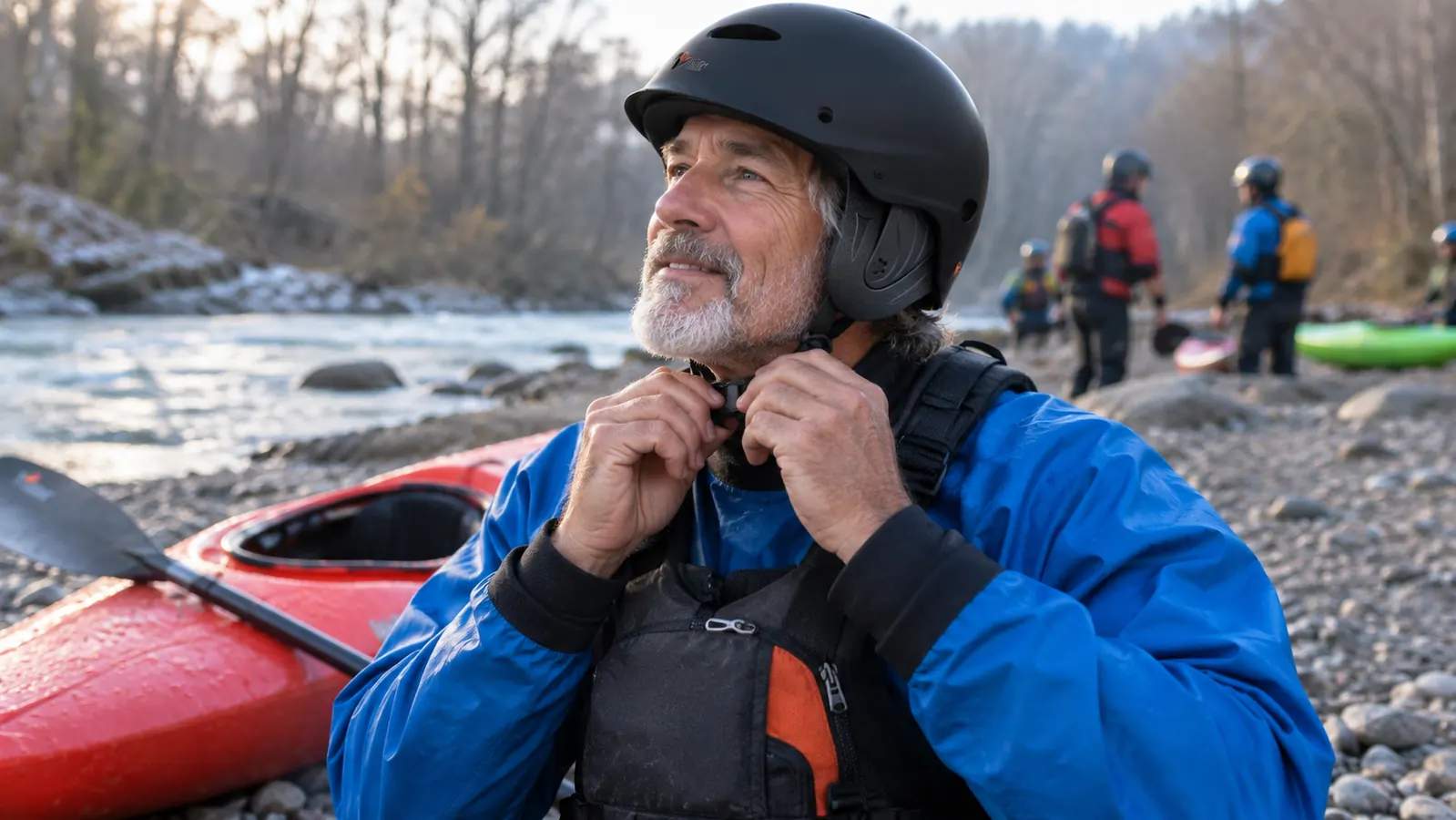
What the Vihir Helmet Is and How It's Built
The shell is ABS, the liner is expanded polystyrene, and the listed weight is 420 grams. It comes in size L, which the listing gives as 59 to 63 centimeters, and the outer dimensions are listed at 10 by 8 by 8 inches. There is a one-year warranty. The ear panels are a molded part of the design rather than a strap-on extra, and the listing describes them as protection that does not affect hearing. That last detail matters more than it sounds like it does.
Ventilation is eleven vents total, with channels molded into the front of the shell. In practice that number tells you what the helmet is for. A whitewater helmet usually runs fewer and smaller vents, because every hole in a shell is a place the shell is not. Eleven vents is a design choice that leans toward airflow and comfort on long, hot days, and for the paddler this is aimed at, I think it is the right trade.
The Vihir helmet does not carry a claim of meeting a whitewater certification standard, and I am not asserting one on its behalf. It is sold as a water sports helmet. That is not a knock. It tells you what it is, and the only question that matters is whether what it is matches where you paddle.
On the Water: Weight, Venting, and Cold Mornings
At 420 grams it is light enough that I forget it is on, which is the highest compliment I can give a helmet on a teaching day. I have worn heavier helmets that left my neck tired by mid afternoon, especially on days when I am craning to watch a student in an eddy above me or looking for a line through a rapid. That has not happened with this one.
The venting is genuinely good. July on the Nantahala can be muggy, and the front channels move air when you are working. The other side of that coin shows up in cold water. On a spring runoff morning the water comes off the bottom of the dam and it is cold enough to take your breath, and eleven vents means a lot of that water finds its way in. I wear a thin neoprene cap under it in March and April, and if you paddle cold water you will too.
It is light enough that I forget it is on, and I can still hear a student hollering from thirty yards downstream. On a teaching day those two things matter more than anything printed on the box.
There was one release morning in April when the air was in the forties and the water was colder than that, and I kept the helmet on from put-in to takeout because taking it off meant losing the little warmth the ear panels were holding. That is the day I stopped thinking of the vent count as a pure positive. It is a fair trade, and it is a trade you should make with your eyes open. If you paddle cold water more than warm water, budget for a cap.
The ear panels do what the listing says. Water comes off my ears instead of into them, and I can still hear a student hollering from thirty yards downstream. That last part is the one I care about most. An ear flap that keeps water out and also keeps you from hearing a swimmer in trouble is a bad trade, and I have not found that with the Vihir.
Fit, the Ears, and What Happens When You Swim
Fit is the whole ballgame with any helmet, and the listing says so itself. A badly fitting helmet can be as dangerous as no helmet. Size L covers 59 to 63 centimeters, which is a wide band for a single size, so the adjustment is doing real work here. I set it up once with cold fingers at the put-in and it held all day, through wet exits, a couple of swims, and a lot of climbing in and out of eddies.
I teach fit at the put-in and the drill is this. Put the helmet on, snug the adjustment, then shake your head hard side to side and forward and back. It should not slide down over your eyes and it should not lift off your forehead. The Vihir passes that drill on my head. I have watched the same drill fail on students with smaller heads who tried to make a size L work because it was the size on the shelf. Get the size right, or get a different helmet.
The helmet does come off in a serious swim. I have seen it happen and I have tested it deliberately in a safe eddy with a spotter. A general water sports helmet with a wide size band is not going to lock onto your head the way a whitewater-specific shell with a retention system built for that job will. If you run water where a long swim is a real possibility, that is the difference that should push you toward the purpose-built helmet.
Portaging and carrying bring out the small stuff. The listed outer dimensions are 10 by 8 by 8 inches, so it packs against the back of a pack or hangs off the outside without much fuss. The ear panels do catch on a sprayskirt tunnel when you pull the helmet on in a hurry. Minor annoyance, worth knowing about.
Where It Falls Short
The honest summary is that this is a class II and III helmet for most paddlers, and it should not be your choice for class IV and up. I teach on water that includes class IV sections, and I paddle my own boat there too, and on those days I wear a whitewater-specific helmet. That is not a criticism of the Vihir. It is a statement about what the helmet is designed for, and I would give the same advice about any general water sports shell.
I get asked whether a general water sports helmet is fine for a beginner and not fine for an experienced paddler. I do not think that is the right way to split it. The right split is the water, not the paddler. A first-year paddler on the Ocoee release is in more serious water than a twenty-year paddler on a lazy class II float, and the helmet should match the water, not the resume.
The second limitation is that no helmet makes you safe. I tell students this at the put-in and I will write it here. A helmet buys you margin. It does not buy you a roll, a brace, a clean line, or the judgment to walk a rapid that is above your ability on that particular day. Gear does not replace training and it does not replace judgment, and anyone who tells you otherwise is selling something.
The third is small. The ear panels run warm in still air. On the drive home with the windows up, I take it off. That is not a reason to avoid the helmet, but it is the kind of detail most reviews skip.
What I Liked
- Light at 420 grams, easy to forget on a long teaching day
- Eleven vents with front channels move real air in July heat
- Ear panels keep cold water off without blocking voices downstream
- Size L covers a wide 59 to 63 centimeter band, so one size fits more heads
- ABS shell and one-year warranty held up through a full season in a truck bed
Where It Falls Short
- General water sports helmet, not whitewater-specific, and it says so
- Sits higher on the head than a dedicated whitewater shell
- Eleven vents let cold water in during spring runoff
- Ear panels catch on a sprayskirt tunnel when you pull it on quickly
- Comes off more easily in a long swim than a purpose-built whitewater helmet
Who This Is For
If your paddling lives in the class II and III range, and especially if you are new to whitewater or get out a few weekends a season, this is a sensible helmet. It is comfortable, it vents, it covers your ears, and it will not be the reason you have a bad day. Beginners in my clinics who show up with something like the Vihir are in good shape. So are recreational kayakers and canoeists who want one helmet that works across moving water, flat water, and a rented boat on a family trip.
Who Should Skip It
If you run class IV and harder, skip it and buy a whitewater-specific helmet. If a long swim in a cold, pushy river is a realistic possibility on your usual run, skip it. If you want a retention system designed for whitewater rather than adapted to it, skip it. That is not a knock on the Vihir helmet. It is the right helmet for a lot of people and the wrong one for a smaller group, and I would rather tell you which group you are in than pretend there is no difference.
A fair helmet for a class II and III season, and honest about it
Light, vented, and comfortable enough to keep on all day with your ears covered. If that describes your paddling, it is worth a look. If your water gets serious, buy the whitewater-specific shell instead and put the difference into a rescue course.
Amazon Check Today's Price on Amazon →