

I have been teaching beginner whitewater clinics on the Ocoee and Nantahala for close to thirty years, and the helmet question comes up every Saturday morning. The short answer is this: the Vihir Adult Water Sports Adjustable Helmet with Ears is a reasonable choice for a new paddler who stays on class II and III water, lakes, and easy river runs. A premium whitewater helmet is the better choice for anyone running class IV or harder, or for a paddler who wants a shell built specifically to a whitewater standard. I keep a Vihir on the loaner shelf for students and visiting friends, and I wear a whitewater-specific helmet myself on harder runs. That split tells you most of what you need to know.
Neither helmet replaces training, a good PFD, or judgment. I have seen people buy gear and think it buys skill. It does not. What a helmet does is buy you a little margin when the river takes your feet out from under you, and the amount of margin depends on where you paddle and how the helmet fits. The Vihir costs less and vents better. The premium helmet covers more and is built to a stricter standard. The trick is picking the one that matches the water you actually run, not the water you watch on video.
| Vihir Helmet | Premium Whitewater Helmet | |
|---|---|---|
| Main use | Class II and III kayaking, lakes, easy river days, general water sports | Class IV and harder whitewater, creeking, serious river running |
| Impact standard | No certification claimed by the maker | Built to a recognized whitewater helmet standard |
| Coverage | Covers the skull and includes ear protection | Deeper coverage at the back and temples for whitewater impacts |
| Fit adjustment | Adjustable shell sized for 59 to 63 cm heads | Sized shells plus a whitewater retention system |
| Ventilation | 11 vents | Usually fewer vents because coverage comes first |
| Weight | 420 g | Typically heavier for the added coverage |
| Ear coverage | Ear protection included | Varies by model, some have ear pads, some do not |
| Warranty | One-year warranty | Varies by maker |
| Cost | Lower upfront cost | Higher upfront cost |
| Best for | New paddlers, casual kayakers, class II and III | Experienced paddlers on class IV and harder |
Where the Vihir Wins
The Vihir wins on the things a newer paddler notices first. It is lighter than the whitewater-specific helmets I have handled, at 420 g, and it has 11 vents. On a humid July day on the Nantahala, that matters. The ear protection is built into the helmet, so you do not need to buy a separate pad set or tape foam into place. The adjustable fit covers 59 to 63 cm, which is a wide range, and the one-year warranty is straightforward. For a student who is still figuring out whether they like whitewater, those are real advantages.
It also wins on simplicity. I can put a Vihir on a student who forgot their gear and get it adjusted in a minute. For a family that paddles a few weekends a summer, or a new kayaker who is still renting boats and learning the basics, that is the right trade. I would rather see a student in a properly fitted Vihir than in an expensive whitewater helmet that is two sizes too big and slides over their eyes in a swim. A helmet that fits is doing its job. A helmet that does not fit is a decoration.
The Vihir also wins on the loaner shelf. I keep a few helmets for students and visiting friends, and the Vihir is easy to adjust across a range of adults. The ABS shell and EPS liner are the same basic materials used in a lot of helmets, and the 10 x 8 x 8 inch shell is not so bulky that it feels like a bucket. If you want one helmet for easy river days, lake paddling, and the occasional surf session, the Vihir covers that ground without asking you to spend whitewater-helmet money on a class II boat.
Where the Premium Whitewater Helmet Wins
The premium whitewater helmet wins on the stuff that matters when the water gets steep. It is built to a whitewater helmet standard, and the Vihir does not claim that. The shell and liner are designed around whitewater impacts, with deeper coverage at the back of the head and temples. The retention system is made to stay put when you are getting worked in a hole, not just when you are floating a flatwater section. That is not a small difference. It is the difference between a helmet that is designed for the job and one that is designed for several jobs.
It also wins on fit for hard use. Whitewater helmets usually come in multiple shell sizes and have a retention system you can fine-tune with cold hands. That matters on a cold spring runoff day when you are wearing a hood or a drytop and your hands are numb. The premium helmet costs more and vents less. I accept that trade on class IV, because at that point I am not optimizing for a breeze. I am optimizing for the helmet staying on my head and covering the parts of my skull that are most likely to meet a rock.
The premium helmet also wins on confidence, though I want to be careful with that word. I do not mean it makes you safe. I mean that when I am scouting a rapid and deciding whether to run it, I want my equipment to be one less thing on the list of unknowns. A certified whitewater helmet with deep coverage and a proper retention system removes one small question. The river still has plenty of questions left. That is the honest version of the trade.
If your paddling is class II and III, start with the Vihir
The Vihir Adult Water Sports Adjustable Helmet with Ears gives you ear coverage, 11 vents and a 420 g shell for the river days most of us actually get. Check the current listing and confirm the 59 to 63 cm fit before you buy.
Amazon Check availability on Amazon →How I Check Fit on the River Bank
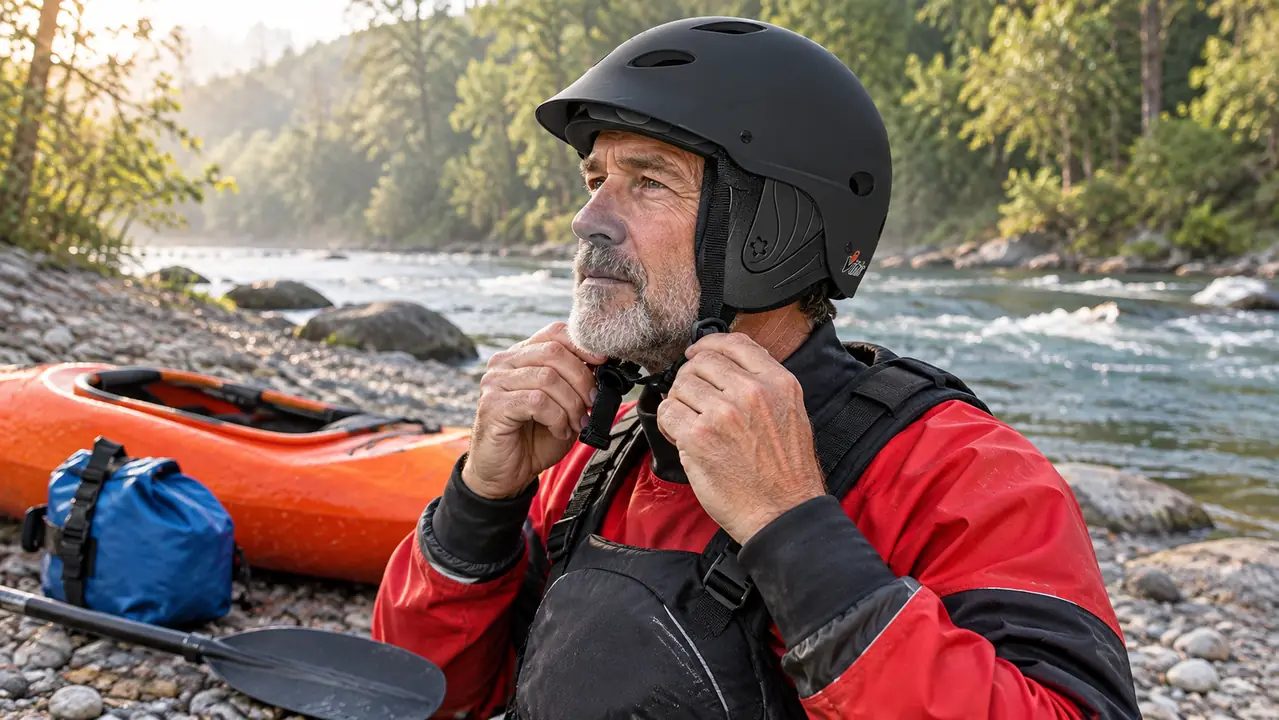
Fit is the whole game with any helmet. A loose helmet is worse than no helmet because it can shift and block your vision. I check three things before a student gets on the water. First, the helmet should sit level, not tipped back like a baseball cap. Second, the front edge should sit just above the eyebrows. Third, when I press up on the front edge, the skin on the forehead should move with the helmet. If the helmet slides independently, it is too loose.
The Vihir's adjustable fit covers 59 to 63 cm, which is a large range, so it can work for a lot of adults. But a range is not a guarantee. If you are at the top or bottom of that range, check the fit carefully or look for a helmet with more shell sizes. The premium whitewater helmet has an advantage here because it usually comes in multiple shell sizes and has a retention system made for whitewater. Still, no amount of adjustment fixes a helmet that is the wrong shape for your head.
I also check ear coverage. The Vihir has ear protection, which I like for cold water and for the odd rock that finds the side of your head. The ear pieces should not press on your ears or muffle sound. You need to hear your partner, the current, and the whistle. If the ear coverage blocks hearing, adjust it or pick a different helmet. Ear coverage is a benefit only when it still lets you communicate on the river.
One more check: I have students shake their head side to side and nod sharply. The helmet should stay put without being so tight that it gives them a headache. The Vihir is adjustable, but it is still one shell size, so the fit is a compromise. The premium helmet is built to be adjusted in more places. That is part of what you pay for. It is also part of why the premium helmet is the better choice for a paddler who spends a lot of days in cold water with a hood.

The Certification Question
This is the part where I will not soften the message. The Vihir is a general water sports helmet. The listing does not claim CE EN 1385 or any other whitewater certification, and I will not pretend it does. If you are running class IV or harder, you should be in a helmet that is built and certified for that use. That is not brand loyalty. It is matching the tool to the job.
I have had this conversation on the bank more than once. A paddler shows up with a general water sports helmet and a plan to run a steep creek section because the flows are up. I tell them the same thing every time: the helmet is not the only issue, but it is part of the issue. A whitewater-specific helmet is designed for repeated impacts and for the kind of coverage you need when the river is pushing you against rock. A general water sports helmet is designed for kayaking, surfing and similar uses. Those are not the same thing.
The Vihir is a good helmet for what it is. I use it for teaching on class II, for lake paddling, and for the easy stretch of the Nantahala where the biggest risk is a low branch. I do not use it when I am running the Ocoee at release levels. That is not a knock on the helmet. It is a recognition that a 420 g adjustable helmet with 11 vents is built for a different day. If you want one helmet for everything, you are going to compromise somewhere. I would rather you know where the compromise is before you get on the water.
A loose helmet is worse than no helmet because it can shift and block your vision.
What I Tell Students
Most of my students are not running class IV this year. They are learning to eddy turn, ferry, and roll on class II. For them, the Vihir is a sensible first helmet. It covers the head, includes ear protection, and has enough vents that they are not cooking on a summer afternoon. The lower cost means they can spend their money on a PFD and a helmet that fits, which is where I would rather see the budget go. I have seen too many beginners buy the most expensive helmet first and then skip the rescue class.
For the students who already have a crew and a creek boat, I say spend the money on the whitewater-specific helmet. You will not notice the extra cost when you are upside down in a hole. You will notice the coverage and the retention. The Vihir is not a bad helmet. It is just not the helmet for that day. I would rather tell you that plainly than sell you the wrong thing. The river does not care what you spent. It cares whether your gear stays on and whether you know what to do.
I also tell them to practice with the helmet on. A helmet that feels fine on the bank can feel different when you are swimming. Take a roll class. Get upside down in a safe eddy. Make sure the helmet does not lift or shift when you are wet. The Vihir can pass that test for a lot of paddlers on class II and III. The premium helmet is more likely to pass it on harder water. Either way, the test is on the water, not in the shop.
Who Should Buy Which
Buy the Vihir if you are new to whitewater, if most of your paddling is class II and III, or if you want one helmet for easy river days, lakes and general water sports. It is also a good choice for a loaner helmet, a family helmet, or a paddler who wants ear coverage without spending whitewater-helmet money. Check the 59 to 63 cm fit and make sure the ear pieces do not block your hearing. Use it for the days it is built for, and do not ask it to be a class IV helmet.
Buy the premium whitewater helmet if you run class IV or harder, if you paddle steep creeks, or if you want a helmet that is built to a whitewater standard and has the coverage and retention that go with it. If you are between sizes, or if you wear a hood in cold water, the premium helmet's sizing and retention are worth the extra cost. Either way, spend the money on training and practice. The helmet is a margin, not a skill. The Vihir is a good first helmet for a lot of paddlers. The premium helmet is the right tool for the harder days. Pick the one that matches your river.
The Vihir is the right first helmet for most class II and III paddlers
It covers the head, includes ear protection, and vents well enough for a summer clinic. Confirm the 59 to 63 cm size range and check the listing before you commit.
Amazon Check availability on Amazon →