

Every April I run the same beginner clinic on the Nantahala, and every April I watch the same thing go wrong in the put-in parking lot. Somebody shows up with a thick rectangular foam vest they bought for a pontoon boat, they wedge themselves into a kayak, and twenty minutes later they are paddling with their elbows pinned against their ribs. They tire out fast. Tired beginners make bad decisions, and bad decisions on moving water are how people get hurt. I have watched a man blame his paddle for a problem that was entirely a piece of foam sitting in the wrong place.
I have taught whitewater for close to thirty years and I have never believed a piece of gear can make somebody safe. Training and judgment do that, and nothing else does. But the wrong vest will absolutely make a competent paddler worse, and that is the honest reason I started paying attention to the Onyx MoveVent Dynamic Paddle Vest. I have now paddled it through cold spring runoff, through a full summer of weekend clinics, and through enough dam-release days on the Ocoee to have an opinion I am willing to put my name on. This is what I found.
The Quick Verdict
The mesh back panel and wide armholes make this the easiest vest I have ever handed to a nervous beginner, and the adjustment range covers nearly every body that walks into my clinic. It loses points for thin shoulder padding and a whistle that rides higher on the chest than I would like.
Amazon Check Today's Price →The vest I hand to first-timers before they ever touch a boat
Adjustable side belts and shoulder straps, a mesh back panel built to clear most kayak and canoe seat backs, and a fit range from 90 to 300 pounds. Check today's price and current sizing on Amazon.
Amazon Check Today's Price on Amazon →How I've Used It
My routine is not glamorous. I paddle a river runner and a solo canoe, I teach two clinics a month from April through August, and I carry a camera in a dry bag because photographing birds and morning light on the water is the other thing I do out there. That means a vest has to survive repeated soakings, a shuttle ride in the back of an older pickup, and being handed from a 100 pound teenager to a 260 pound adult in the same afternoon without coming apart at the seams. I have owned vests that could not manage the third one.
I have worn the Onyx MoveVent on cold runoff mornings when the water is in the forties and the air is not much better, on humid July afternoons when nothing moves, and on long flat stretches where there is nothing to do but paddle and think. I have also put it on students, which is the more useful test. A vest that fits an experienced paddler who knows how to snug a side belt is not the same vest that fits a nervous beginner who has never worn one and is quietly afraid of the water.
So I kept the questions simple. Does it stay where you put it when you reach forward to plant a stroke. Does it let you breathe when you are working hard against a headwind. Does it climb over your ears when you swim. Does anything on it rub, break, or fail quietly after a month. I also asked Karen to wear it on a couple of class II days, since she paddles a different boat in a different style than I do, and a second opinion from somebody who is not an instructor is worth having.
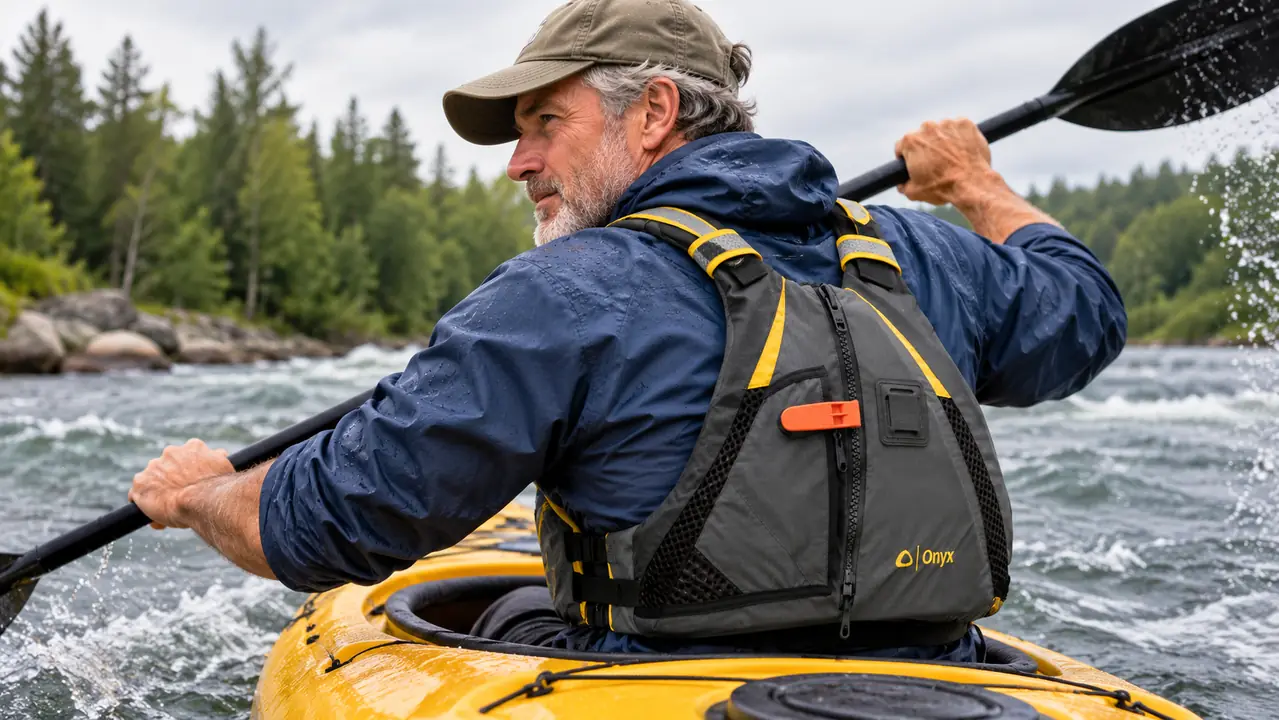
The Mesh Back Panel Is the Whole Point
Most paddling vests fail in one specific and predictable way. The foam in the back panel is thick enough that it presses against the seat back of a kayak, and every time you lean back the vest gets shoved upward an inch. Do that two hundred times in an afternoon and the vest is riding around your neck with the shoulder straps slack and the whole thing sitting somewhere it was never designed to sit. The Onyx MoveVent addresses that with a mesh panel in the back that is built to accommodate most canoe and kayak seats, and that panel is the reason I started looking at this vest in the first place.
In practice, the seat back of my river runner finds that open mesh area instead of a slab of foam, and the vest stays where I set it. I noticed it most on the long flatwater stretches between rapids, the places where you finally relax and lean back and let the current do the work. On my old vest, leaning back was the thing that ruined the fit. On this one, leaning back is just leaning back, and I stopped doing the shoulder shrug adjustment every ten minutes.
It matters in the canoe as much or more. A solo canoe seat with a molded back rest is exactly the shape that fights a conventional vest, and I have spent plenty of river days with a hard edge pressing into my spine. The mesh lets the seat back find its own space. If you have ever finished a day on the water with a raw spot on the back of your neck and no idea why, that is the problem this panel is solving, and it solves it quietly, without you noticing until somebody asks why you stopped fidgeting.
Fit and Adjustment Across a Full Clinic
The Onyx sizing is a single Medium-Large, and the listed fit range runs from 90 pounds up to 300. I am 61 years old, about 175 pounds, and I wear it over a base layer and sometimes over a dry top. The adjustable side belts and the shoulder straps are what make that range work at all, and the neoprene in the shoulder area is what keeps the straps from sawing at you when everything is wet, which on a river is most of the time.
Here is the test I actually run, and it takes about five minutes. I put the vest on a small paddler and a large paddler in the same clinic and have both of them paddle a hundred yards. Neither one should have the vest climbing up. Neither one should have the shoulder straps floating loose. Neither one should be tugging at it while they are supposed to be watching the water ahead of them. With the side belts pulled in, the smaller paddlers were fine. With them let out, the bigger ones were fine. I have not yet met a student in that range who could not be fitted.
The honest caveat is that one universal size will leave a long tail of strap hanging on a very small frame. That is not a defect so much as it is what a one-size-fits-most design means, and you deal with it by tucking the excess rather than pretending it is not there. Somebody at the bottom of that range should take the extra three minutes to get it right on land before they get on moving water. Three minutes in a parking lot beats an afternoon of adjusting in an eddy, and the side belts are the part everybody yanks on, so getting them set once is worth the trouble.
The Whistle, the Reflectives, and the Details I Actually Use
There is a built-in whistle on this vest. I have needed a whistle for real exactly twice in thirty years, both times to get a scattered group's attention from a distance, and both times I was glad it was attached to the vest and not buried in a dry bag under a camera. That is the entire argument for it. You will not need it often. When you need it, you will not have time to go looking.
The reflective accents are SOLAS grade, which means they are built to the standard used for survival equipment at sea rather than being a stripe of shiny tape someone added for looks. I notice them most at dusk and at the takeout, when the light is going and the truck is a quarter mile down a gravel road with headlights coming the other way. On a winter shuttle that is not a small thing, and it is the sort of detail you only appreciate after one late takeout in bad light.
The closure is a zipper plus buckles, which is what I prefer. The zipper gives you a consistent front panel every time you put it on, and the buckles are what you actually tension. The nylon shell has taken abrasion from boat decks, trailer rails, and one memorable slide down a gravel put-in without any visible damage. At 1.7 pounds I forget I am wearing it on the flat sections, and for safety gear that is close to the highest compliment I can pay.

What a Season of River Days Did to It
I am hard on gear in a boring way. I do not abuse it, I just use it constantly and put it away wet. The Onyx MoveVent has been soaked and dried maybe forty times now, hung over a truck bed rail in the sun, and stuffed into a boat compartment still damp more than once because the shuttle was leaving and I was not going to be the reason it did not. The zipper still runs clean. The neoprene edging has not cracked or gone gummy. The mesh panel has not sagged or stretched out of shape.
The warranty is one year from the manufacturer, which is standard for the category and worth knowing if a buckle ever gives up. I have not had to test it. More to the point, I have not had a strap pull loose from its stitching, which is the failure I have seen on cheaper vests after a single season of beginners grabbing the shoulder strap to haul themselves up out of a boat. That is the kind of failure that shows up with no warning and at the worst possible moment, and it is the one I check for first.
Where the MoveVent Falls Short
The shoulder padding is thin. That is fine in a boat and it is not fine when you are carrying two boats up a bank or dragging a loaded canoe over a rocky portage. On a long carry my shoulders felt every bit of it, and I am not carrying these things for fun. If your paddling involves a lot of walking with a boat, that is a real consideration and you should weigh it honestly before you buy.
The whistle sits higher on the chest than I would place it, close enough to the collarbone that a bulky dry top can crowd it, and you have to be deliberate about grabbing it instead of pawing at your own chest. The universal sizing also leaves that long strap tail on smaller paddlers, as I said. Neither of those would stop me from buying it again. Neither of them is nothing, either, and I would rather tell you now than have you find out on a cold morning twenty feet from the put-in.
What I Liked
- Mesh back panel clears most kayak and canoe seat backs, so the vest stops climbing
- Large armhole openings let you reach forward and plant a stroke
- Side belts and shoulder straps cover a 90 to 300 pound fit range
- Built-in whistle is attached to the vest where you can reach it
- SOLAS-grade reflective accents are visible at dusk and on the shuttle road
- Nylon shell and neoprene edging held up through a full season of soakings
- 1.7 pounds, light enough to forget on flatwater
Where It Falls Short
- Shoulder padding is thin for carrying or dragging a boat
- Universal sizing leaves a long strap tail on small paddlers
- Whistle rides high on the chest and can be crowded by a bulky dry top
I have put this vest on a 100 pound paddler and a 260 pound paddler in the same afternoon, and both of them could reach forward and plant a stroke without the vest climbing toward their chin.
Who This Is For
This is the vest I would hand to a beginner, a casual river paddler, or an instructor who needs a few loaners that will fit almost anybody who shows up on a Saturday morning. It is also a sensible choice for someone running class II and easy class III in a boat with a seat back who wants to stop thinking about their shoulders halfway through the day. The mesh panel, the armholes and the adjustment range are the three things that matter here, and all three of them do what the listing says they do. If you have been paddling in a borrowed lake vest and wondering why your neck hurts, start here.
Who Should Skip It
If you run class IV and up, or you swim big water regularly, look at a vest built for that instead. Thin shoulder padding and a general purpose cut are not what you want in a serious hole, and no vest on the market replaces the judgment that keeps you out of one. If you carry boats long distances, the padding will bother you. And if you are well under 90 pounds, this is not your vest, which sounds obvious until you watch somebody try it anyway.
Stop paddling around a vest that fights your seat back
The mesh back panel, the wide armholes and the 90 to 300 pound fit range are the three reasons I keep handing this one to students. Check today's price and current sizing on Amazon.
Amazon Check Today's Price on Amazon →