

Short answer first, because that is what you came for. If your paddling is class II and the easier class III, if you fish from the boat, or if you shoot photos from the bank, buy the Onyx MoveVent Dynamic Paddle Vest and put your effort into a swiftwater rescue course instead. If you run class IV, practice live-bait rescues, or guide water where somebody may need to clip you into a rope system, buy a rescue-style whitewater vest with a full webbing harness. These are not two versions of one product. One is a paddling vest. The other is rescue equipment that you happen to wear while paddling.
I am Russ Tolliver. I am 61, I have been in whitewater about 30 years, and I teach weekend beginner clinics near the Ocoee and the Nantahala in western North Carolina. I paddle one river runner and one solo canoe, and both ride a two-boat rack on an older pickup. My wife Karen paddles class II and III with me and runs shuttle on the days when the release is pushing. I have worn the Onyx MoveVent through a lot of clinic days, mostly because it is easy to keep on from the put-in to the take-out. That is the honest starting point for a comparison like this one.
| Onyx MoveVent | Rescue-style whitewater vest | |
|---|---|---|
| Back panel | Mesh panel cut to sit over most canoe and kayak seat backs | Solid back panel with harness webbing that can bunch against a tall seat back |
| Armholes and reach | Large armhole openings, full reach for a forward stroke and a sweep | More foam across the chest and shoulder, less reach at the top of the stroke |
| Rescue hardware | Zipper and buckle closure, adjustable side belts and shoulder straps, no webbing harness | Full torso webbing harness, quick-release belt and a clip-in point for a rope system |
| Flotation in big water | Enough margin for class II and III days, less reserve in a long swim in a heavy hole | More foam and more coverage, built for a rough swim in big volume |
| Sizing range | Medium-large universal fit, rated 90 to 300 pounds | Sold in fixed sizes, fit depends on harness adjustment |
| Weight | 1.7 pounds | Heavier once the harness and the extra foam are added |
| Cargo and camera storage | No front cargo pocket listed, so a camera dry bag rides in the boat | Large front pocket that holds a throw bag or a compact camera case |
| Visibility and signal | Built-in whistle and SOLAS-grade reflective accents | Whistle and reflective trim vary by maker, so read the label |
| Warranty | 1 year manufacturer | Varies by maker |
| Best for | Class II and III paddling, fishing, photography, clinic fleets | Class IV and up, rescue practice, guide and safety work |
What the Onyx MoveVent Is Actually Built For
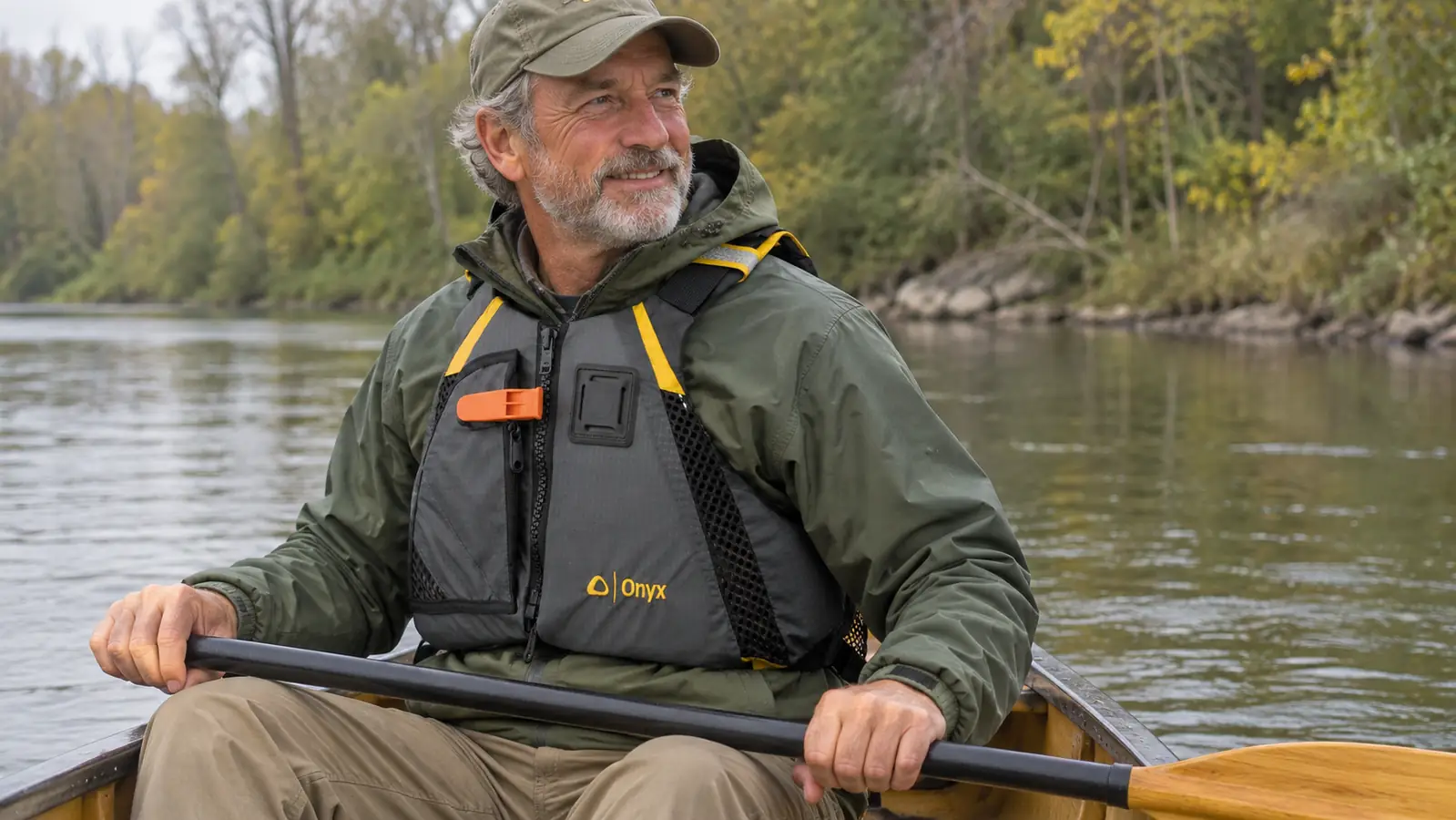
Start with the facts on the label. The MoveVent is a nylon vest in a medium-large universal fit, rated for paddlers from 90 to 300 pounds, and it weighs 1.7 pounds. It closes with a zipper and a buckle, and the side belts and shoulder straps adjust so you can snug it over a dry top or a t-shirt. None of that is exotic. What makes it a paddling vest rather than a general life jacket is the back panel: mesh, cut to sit over most canoe and kayak seat backs, so the foam is not fighting the seat back every time you lean into a stroke.
That back panel matters more than it sounds. In my solo canoe I kneel, and the seat back sits low, but on a long flat stretch I lean against it. In the kayak the seat back is taller, and the mesh lets the vest settle instead of climbing up around my ears after the third eddy turn. The large armhole openings do the same job for the front of the stroke. I can demonstrate a forward stroke, a sweep, and a low brace from the bank, then get in and do all three without the vest binding at the shoulder. The neoprene on the shoulder straps is the small detail that keeps a wet strap from rubbing a raw line into your neck by two in the afternoon.
There is a built-in whistle on a cord I can reach without looking down, plus SOLAS-grade reflective accents across the shoulders. I have used that whistle to get a swimmer's attention and to wave off a boat that was about to run the wrong line. There is no cargo pocket listed on this vest, so my camera dry bag stays in the canoe within reach of my knee. That is not a flaw in the design. It is a fact, and it is one of the places where a rescue vest pulls ahead of it.
What a Rescue-Style Whitewater Vest Is Actually Built For
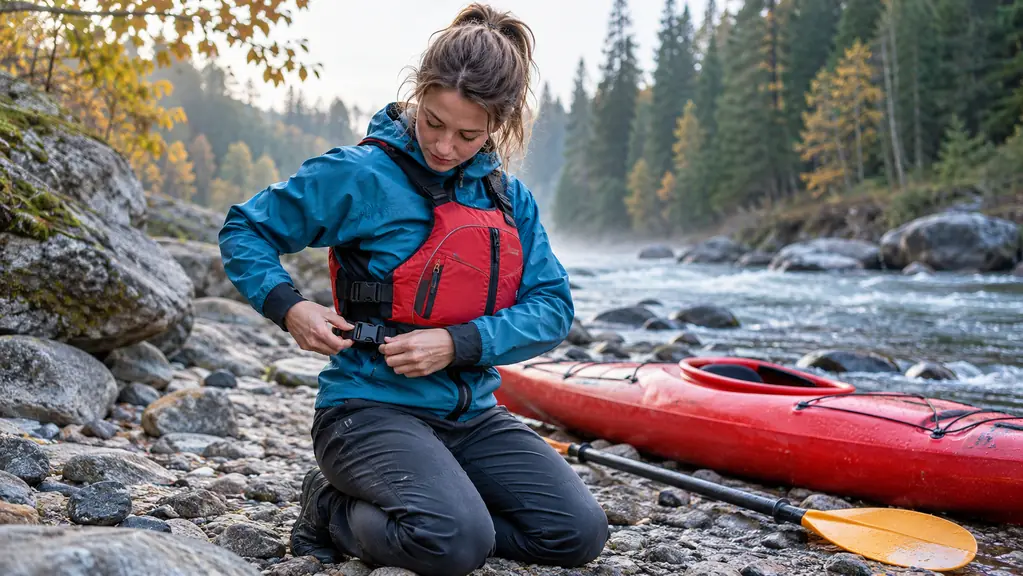
A rescue-style whitewater vest is built around a full torso webbing harness. That harness runs over the shoulders and around the waist, and it usually comes with a quick-release belt and a clip-in point at the front. The purpose of all that webbing is not comfort. It is so a swimmer in a hole can be clipped into a rope system from the bank, and so a paddler wearing the vest can be hauled out of the water under control instead of by a sleeve. The class also tends to carry more foam, more coverage across the chest, and a large front pocket sized for a throw bag or a compact camera case.
All of that hardware costs you something. A rescue vest is heavier than 1.7 pounds, warmer on a July release day, and it sits over the seat back instead of settling behind it. The harness needs maintenance too. You check the webbing, you check the buckle, and you practice the quick release until your hands find it without a look. A quick-release belt that has never been drilled is hardware you are carrying and cannot use. I tell students that plainly, and I say the same thing about a throw bag they have never thrown.
The mesh back panel is the reason I stopped taking the vest off between laps. On a hot June clinic day, that is the entire argument.
Where the MoveVent Wins
Comfort over a long day, and it is not close. The mesh back panel, the large armholes, and the 1.7-pound weight mean I forget I have it on. When I am teaching I am in and out of the boat twenty times, walking boats up a bank, and kneeling in the gravel to show a brace. A vest that rides up or traps heat gets unbuckled and left on the bank, and a vest on the bank is not doing anything for anybody. On a class II and III day on the Ocoee, that comfort is the difference between a vest worn at the take-out and a vest that was decoration at the put-in.
The second win is the fit range. A medium-large universal fit rated from 90 to 300 pounds, with adjustable side belts and shoulder straps, means the clinic fleet fits a teenager and a grown man on the same Saturday. If you lend gear, teach, or paddle with family, that range is worth more than a feature you will never touch. Karen is smaller than I am and the same vest adjusts to her with belt to spare, which is not something I can say for every fixed-size vest on my rack.
Where the Rescue Vest Wins
It wins when the water gets big enough that a swim turns into a rescue. A vest with a harness and a quick-release belt lets a trained paddler clip in, and lets a swimmer be pulled out of a sieve or a hydraulic instead of hoping they flush. I have watched that happen and it was not hypothetical. The extra foam and coverage also buy margin in a long, cold swim, and cold is the thing I take most seriously here in March and April, when the release water comes off the bottom of the dam and the air is warm while the water is not.
The pocket matters too. A large front pocket holds a throw bag, a knife, or a camera case where you can reach it without turning around. I shoot birds and mountain scenery from the boat, and on the days I am working rather than fishing, I want the camera on my chest and not behind my seat. Guides and instructors who spend the day setting safety rather than running the rapid will get more out of that vest than I get out of mine, and they should own one.
For Class II and III Days, This Is the Vest That Stays On
Adjustable side belts, a mesh back panel cut for a canoe or kayak seat, large armholes for a full stroke, and a built-in whistle. The Onyx MoveVent is the one I keep on from put-in to take-out.
Amazon Check Today's Price on Amazon →The Part That Does Not Show Up on a Spec Sheet
Neither vest makes anybody safe. I mean that literally. A personal flotation device keeps you at the surface and buys time for a rescue, and that is a large thing, but it does not teach you to read a horizon line, it does not keep you out of a keeper, and it does not replace a helmet, a throw bag, and a friend on the bank with a rope. I have pulled swimmers out of water who were wearing better vests than mine. What kept them out of trouble was that somebody had practiced and was in a position to help.
The other thing I tell every clinic is to swim on purpose. Pick a warm day, wear the vest, and float a class II rapid in a safe swimmer position with your feet up and your eyes downstream. A vest you have never swum in is a vest you do not know. Both of these vests will float you. Only one of them will let you clip into a rope, and only if you have drilled the release and the person on the bank knows how to use the other end of that system. Gear is the smallest part of the equation, and it is the part you can buy.
Cold water deserves its own line. The releases here run in the forties in spring, and a heavy swim in water that cold is a different problem than the same swim in August. If that is your season, weight the decision toward coverage and toward whatever you will actually wear for the whole run. The best vest in the world is the one that is still buckled when the eddy line grabs you.
Who Should Buy Which
Buy the Onyx MoveVent if your honest paddling year is class II and III, flatwater, fishing, photography, and lake days, and if you want a vest that stays on when the sun is out. It is also the sensible clinic and family vest, because one size covers 90 to 300 pounds. If you are a beginner still learning to roll and to read water, this is the vest to learn in, and the harness you are not ready for is not a loss. Put your time into instruction and a swiftwater course, because those two things change outcomes more than webbing does.
Buy the rescue-style vest if you run class IV, if you guide or instruct where you are setting safety, if you paddle big volume, or if you are already trained and want the harness as part of your kit. If you want a camera or a throw bag on your chest rather than behind your seat, that front pocket is worth the extra weight. I would add one condition. Do the course first or at the same time. Carrying a harness without the training is a way to feel prepared without being prepared, and I have seen that cost people on rivers where the margin was thin.
One Vest, No Guessing: The Paddling Vest Most Days Call For
Medium-large universal fit, rated 90 to 300 pounds, 1.7 pounds on the shoulder, and a mesh back panel built for a kayak or canoe seat. Read the size chart before you commit, then get it wet.
Amazon See Today's Price on Amazon →