
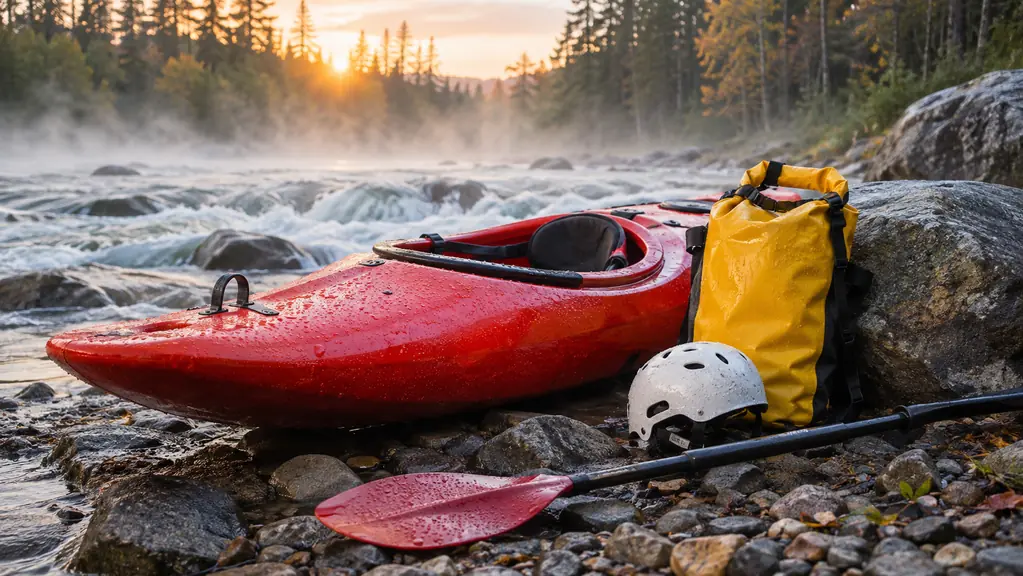
I have carried the Earth Pak Waterproof Dry Bag Roll Top Backpack in the 20 liter size for seven months of river days, and the short version is this: it has kept my camera, phone, and spare layers dry through rain, bilge water, and two swims I would rather not repeat. I am 61, I teach beginner whitewater clinics on the Ocoee and Nantahala, and I have paddled whitewater for about 30 years. I do not trust gear easily. A dry bag has one job, and most of them fail it at the seam, the closure, or the point where a strap pulls loose.
The Earth Pak bag is a 20 liter roll top dry bag made from 500D PVC. It weighs 13.6 ounces, measures 9.5 by 9.5 by 17 inches, and comes with an IPX8 certified waterproof phone case. The closure is listed as a snap, the strap is adjustable, and there is a utility pocket. Those are the facts from the listing. The rest of this review is what those facts felt like after months of loading and unloading on gravel bars, in rain, and in the back of my pickup.
The Quick Verdict
A tough, simple 20 liter dry bag that kept a camera dry after a real swim. The strap is basic, so treat it as a boat bag, not a hiking pack.
Amazon Check Today's Price →The 20L Earth Pak bag that kept my camera dry after a swim
This is the exact size and closure I have used for seven months on western North Carolina rivers. Load it, roll it, snap it, and check it before you push off.
Amazon Check Today's Price on Amazon →How I've Used It
The bag has lived in the stern of my river runner and in the bottom of my solo canoe. On clinic days I load it with a small camera body, a dry layer, lunch, a headlamp, and the phone case. On personal days with Karen, my wife, it carries the same kit plus a compact tripod. Karen paddles class II and III and runs shuttle on the harder days, so the bag often moves from boat to truck to bank without much ceremony. I am not gentle with it. It gets dropped on gravel, stuffed under a seat, and sat beside wet helmets.
I started using it in late winter, which in western North Carolina means cold runoff and dam release schedules that can turn a familiar line pushy. The bag rode through spray and rain. It sat in puddles in the boat. It got stepped on once at the takeout. I did not baby it. The 500D PVC shell has scuffed, but I have not found a tear or a pinhole. The roll top still closes with the snap and still holds a seal when I fold it correctly. That last part matters. A roll top is only as good as the fold. I load it the same way every time: the padded camera case first, then the dry layer, then lunch on top where I can reach it without unpacking the whole bag. On a February clinic day with the water in the low forties, I watched a student pull his phone out of a soft bag that had no roll top, and the screen was already wet. That afternoon I re-folded my own closure three times before pushing off. Bag order and the fold at the top are the two habits that have kept my contents dry.
The most useful test came in April on a dam release day. I missed a ferry in a wave train and went over. I came up with my paddle and my boat, but my camera was in the bag in the stern. When I emptied the boat, the inside of the Earth Pak bag was dry. The camera worked. The phone case was dry too. That is not a story about the bag making me a better paddler. It is a story about the bag doing its one job after I made a mistake. I have also used it on rainy shuttle days and on a week of beginner clinics where the bag sat on the bank from morning to afternoon. It has not failed me yet.
One thing I have not done is treat it as a submarine. I have not deliberately sunk it for minutes at a time. I have not used it as a throw bag or a drag bag. My use is what most paddlers need: spray, rain, bilge water, a short swim, and the wet floor of a truck. In that range, the 20 liter Earth Pak bag has been reliable.
The Roll Top and 500D PVC in Real Conditions
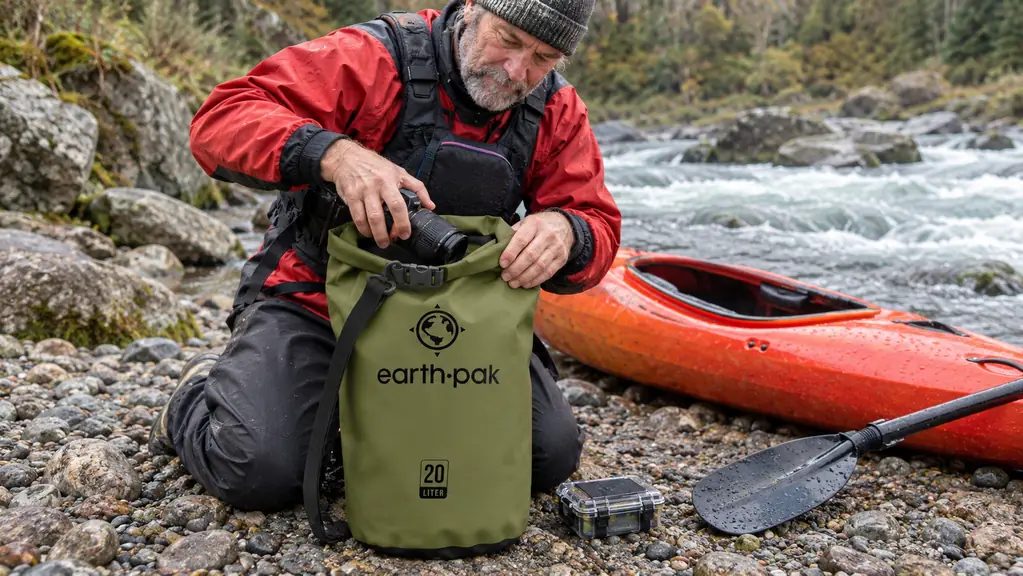
Roll top bags are simple, and simple is why they work. You load the bag, fold the top over, and close it. The Earth Pak bag uses a snap closure at the top. The snap does not do the waterproofing by itself. The fold does. The snap keeps the rolled top from flopping open while you carry the bag by the web handle or the shoulder strap. If you leave the top rolled badly, water will find the gap. That is true of every roll top I have used, and it is the first thing I check before I push off. Before this bag I carried a taped seam bag with a zip closure. The tape lifted at one corner after a single season and I retired it. The roll top has no tape and no zip to fail, which is most of why I switched. I still keep a small hard box for the camera on overnight trips, and if I expected to be pinned against a rock I would take the box over any soft bag. The two solve different problems.
500D PVC is a heavy fabric for a day bag. It is not the lightest material on the market, but it shrugs off abrasion from gritty boats, rocky banks, and the metal edges of a truck bed. I have dragged the bag across a gravel bar by the handle. It has a few dull scuffs. No seam has opened. The material also does not soak up water, so the bag stays light when it is wet on the outside. At 13.6 ounces, it is not a burden in the boat. I have carried heavier camera bodies.
The included IPX8 certified waterproof phone case is a nice practical addition. I have used it for my phone on rainy days and for a small headlamp. I would not treat the case as a substitute for closing the dry bag, and I would not trust any case without checking the seal first. But it is one less thing to buy, and it has kept my phone dry when I needed a shuttle text at the takeout. The case lives in the utility pocket when I am not using it.
The dimensions matter more than they sound. At 9.5 by 9.5 by 17 inches, the 20 liter bag is tall and narrow enough to slide behind a seat or beside a thwart. It does not sprawl across the bottom of the boat. That makes it easier to pack and easier to find with a hand in cold water.
Carrying a Loaded 20L Bag
Earth Pak lists an adjustable shoulder strap for the 10 liter and 20 liter sizes, with a range of 24 to 42 inches. On the 20 liter bag, that strap is the main carry option. There is also a web handle at the top. I use the handle for short moves from truck to boat. I use the shoulder strap for the walk from the put in to the water, or for carrying the bag up to the road when Karen is waiting with the truck.
The bag is not a framed backpack. It does not have a hip belt, load lifters, or a rigid back panel. The title calls it a roll top backpack, and with the shoulder strap it can be worn over one shoulder, but I would not plan a long portage around it. For a day of whitewater, where the bag lives in the boat and moves a few hundred yards at a time, the simple strap is enough. For a multi mile hike into a put in, I would want a different pack or a smaller load.
The utility pocket is useful for small items I want to reach without opening the main compartment. I keep the phone case there on dry days and a small packet of lens cloth on wet ones. The 20 liter size is right for a camera, a layer, lunch, and a few small tools. If you carry a larger camera kit with multiple lenses, the 20 liter will fill up fast. Earth Pak makes larger sizes, but I have only used the 20 liter. One caution on the strap: I tried lashing the bag under the deck rigging of my canoe on one trip and did not like it. I could not reach it in a rapid, and I did not care for the weight up front when the boat heeled. It went back in the bottom of the boat, which is where it has stayed.
The web handle is strong enough for a loaded bag. I have carried it by the handle with a camera, a full water bottle, and a rain jacket inside, and the handle did not stretch or cut into my hand. The shoulder strap is less comfortable when the bag is heavy. It is a simple strap, not a padded harness. That is the tradeoff for a bag that weighs 13.6 ounces.
Where It Falls Short
First, a dry bag is not a dry box. It protects against water, not impact. If you drop a bag with a camera inside onto a rock, the camera still takes the hit. I pack a camera in a small padded case inside the dry bag, and I still treat the bag like it holds something fragile. The Earth Pak bag has scuffed and kept going, but I would not sit on it or use it as a cushion.
Second, the roll top depends on the user. If you are in a hurry and close it with one fold, or if you leave the top pinched in a strap, water can get in. I have seen this happen with every brand. The snap helps keep the top closed, but it does not correct a bad fold. I check my closure before every rapid, the same way I check my sprayskirt. That habit is worth more than any feature on the bag. I had one close call in June, on a hot afternoon when I was rushing to beat a thunderstorm. I closed the top with a single fold and a careless snap. Halfway down the first rapid I remembered, and I pulled into an eddy to re-roll it properly. There was water sitting in the fold, though nothing had reached the inside. I have slowed down since.
Third, the 20 liter size is a day bag, not an expedition bag. It does what I need for a clinic or a half day on the river. It is not large enough for a full overnight kit. Earth Pak lists sizes from 5 to 55 liters, so there is a size for a bigger trip, but the 20 liter is the one I can speak to.
Fourth, the shoulder strap is simple. It works. It is not padded like a backpack strap, and on a long walk with a full bag it can dig in a little. That is the tradeoff for a bag that weighs 13.6 ounces and stuffs into a boat. If you want a pack with a real harness, this is not that product.
What I Liked
- Kept a camera, phone, and spare layer dry through rain, bilge water, and a real swim.
- 500D PVC shell has taken scuffs on gravel and truck beds without a tear or pinhole.
- Roll top with snap closure is fast to open and close once you build the habit.
- 20 liter size fits a day kit and slides into the stern of a kayak or the bottom of a canoe.
- Includes an IPX8 certified waterproof phone case.
- Adjustable shoulder strap and web handle make short carries easy.
Where It Falls Short
- Not a framed backpack. The simple strap is not built for long portages.
- Roll top must be folded correctly or it can leak.
- No impact protection for a camera or other fragile gear.
- 20 liter size is too small for an overnight kit.
- Shoulder strap can dig in when the bag is heavy.
After a missed ferry in a wave train, I emptied my boat expecting the worst. The camera inside the Earth Pak bag was dry.
Who This Is For
The Earth Pak 20 liter dry bag is for paddlers who need a simple, tough bag for a day on the water. It fits a camera, phone, layer, lunch, and small tools. It is a good match for whitewater kayakers and canoeists who keep the bag in the boat and carry it short distances. It is also a reasonable choice for a beginner who wants one bag that can handle rain, spray, and an accidental swim without a complicated setup. I use it in a teaching boat because I can load it, close it, and check it fast. It also suits a photographer who wants a camera close at hand on the river, as long as you pad the camera inside.
Who Should Skip It
Skip it if you need a framed backpack for a long approach hike. Skip it if you carry a large camera kit and need dividers and quick access. Skip it if you want a hard case for fragile gear or if you routinely run rapids where a bag could be pinned and battered. And skip any dry bag if you are not going to close it correctly. Gear does not replace training, judgment, or a good roll. The bag kept my camera dry after a swim, but the swim was my mistake, and no bag would have fixed it.
The 20L Earth Pak bag I trust with a camera in the boat
This is the size and closure I have used for seven months on the Ocoee and Nantahala. If you need a simple dry bag for day trips, start here, then check the closure every time you push off.
Amazon Check Today's Price on Amazon →