
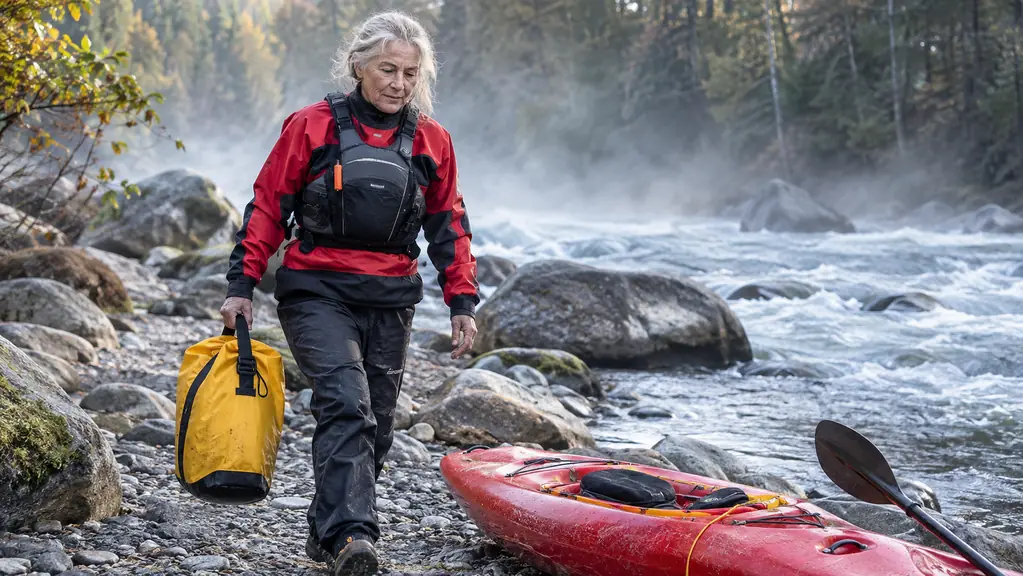
Every river trip forces a small packing decision: what gets wet if you swim? I have watched paddlers jam a hard dry box behind a seat and fight it all day. I have watched other paddlers roll a soft bag tight, drop it into a canoe, and pull it out dry at the takeout. The Earth Pak Dry Bag and a hard dry box solve the same problem, but they solve it for different paddlers.
Here is the short answer. For most day trips in a whitewater kayak or solo canoe, the Earth Pak 20L Dry Bag is the easier piece of gear to live with. It fits odd spaces, carries on a shoulder strap, and handles soft gear plus a camera in a padded insert. A hard dry box is the better choice when you need rigid crush protection and you have one fixed spot for it. I use both, depending on the run and what Karen and I are carrying.
| Earth Pak Dry Bag | Hard Dry Box | |
|---|---|---|
| Cost | Lower upfront cost | Higher upfront cost |
| Water protection | 500D PVC, roll top seal, waterproof construction, IPX8 phone case included | Gasketed shell protects well when latches and seal stay clean |
| Crush protection | Soft body, contents can be compressed if packed carelessly | Rigid shell resists crushing and impact |
| Fit in a kayak or canoe | Soft body conforms to hull and odd spaces | Fixed shape needs a rectangular space |
| Carry on a portage | Adjustable shoulder strap on 10L and 20L, plus web handle | Usually a rigid handle, shoulder carry varies by model |
| Organization | One main compartment plus a utility pocket | Rigid body holds shape and stacks small items |
| Weight empty | 13.6 ounces | Usually heavier than a soft bag |
| Repair after river abuse | PVC can be patched, but seams and coating need care | Cracks and broken latches are harder to fix |
| Best for | Soft gear, cameras in an insert, travel light | Fragile gear and rigid organization |
Where Earth Pak Dry Bag Wins
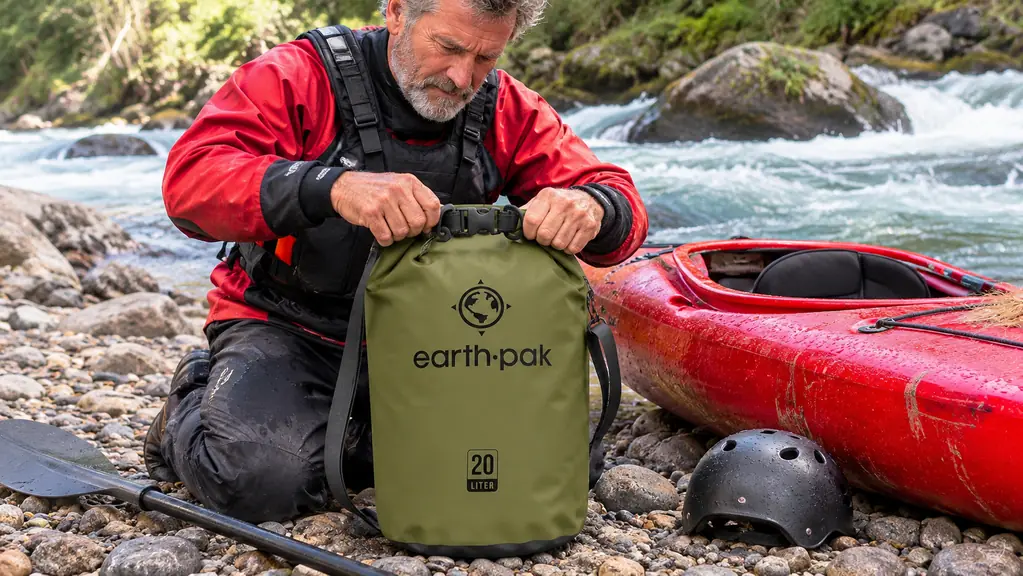
The first win is fit. My river runner does not have a rectangular cargo bay. The space behind the seat is a strange wedge, and the space in front of my feet changes when I adjust the seat. A hard box has to go where its shape allows. The Earth Pak bag can be packed full and fat or rolled down and thin. Its 20L body measures 9.5 by 9.5 by 17 inches, but the soft PVC gives when the hull curves. I can push it into a tight spot and still get it out with the web handle.
The second win is carry. On a short portage, any box with a handle works. On a long one, the shoulder strap matters. The 10L and 20L Earth Pak bags include a 24 to 42 inch adjustable shoulder strap, and the bag weighs 13.6 ounces empty. I can sling it over one shoulder, carry a paddle in the other hand, and walk a quarter mile without the bag banging my shin. The utility pocket also gives me a place for the IPX8 phone case so it is not loose in the main compartment.
Where a Hard Dry Box Wins
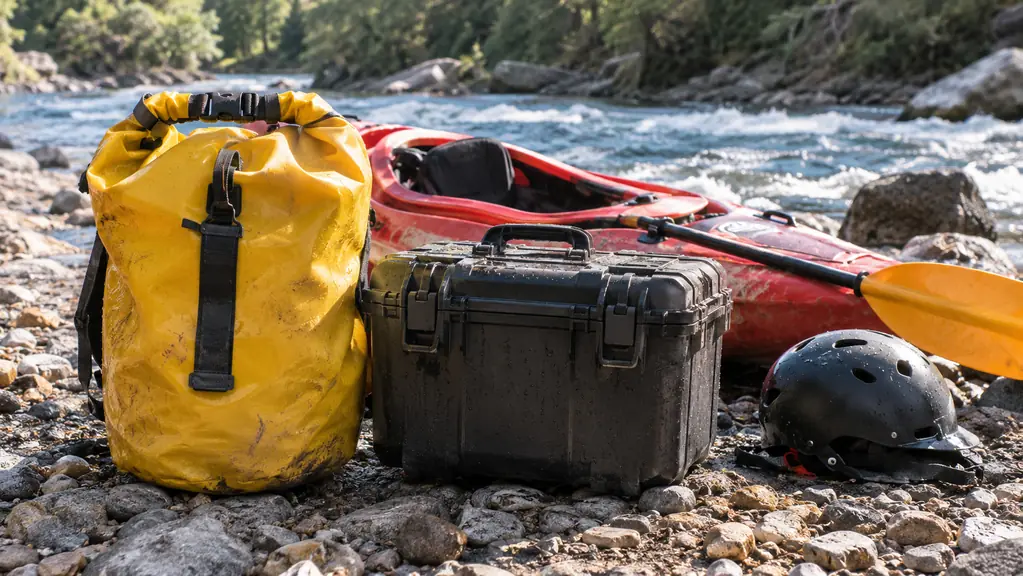
The hard box wins on crush protection, and I do not pretend otherwise. A soft bag protects gear from water. It does not protect a camera body from a boat landing on it or from a pinning situation where the bag is squeezed against a rock. If I am carrying a full camera kit with a hard lens, or if I am on a trip where gear gets stacked and kicked, the rigid shell is the better tool. That is the trade: the box takes one shape and refuses to give.
The hard box also wins on organization. A rigid body holds its shape when you open it on a gravel bar. Small items stay in place instead of sliding to the bottom of a soft sack. The cost is that every latch and gasket needs attention. A grain of sand in the seal, or a latch that does not click, can let water in. A hard box can also crack if it is dropped on rock. I have seen both failures, and neither one is rare.
If you want the bag that fits the boat, start here
The 20L Earth Pak Dry Bag has the roll top seal, the shoulder strap and the 13.6 ounce carry weight that make it easy to live with on a day run. Check the current listing and pick the size that matches your gear.
Amazon Check Today's Price on Amazon →How I Tested Both on the River
I have paddled whitewater for about 30 years and teach weekend beginner clinics on the Ocoee and Nantahala. My testing is not a lab test. It is the same thing I ask students to do: pack the gear you actually need, seal it, put it in the boat, and run a normal day. That means spray, rain, a wet exit in a practice eddy, and a lot of loading and unloading on gravel.
I used the Earth Pak 20L in my river runner and my solo canoe on cold spring runoff days. I carried a dry top, a fleece, lunch, a small first aid kit, and my camera in a padded insert. On dam release days when I carried more camera gear, I used a hard dry box in the solo canoe. Karen paddled her own boat and did shuttle on the harder days. I did not test either one as a flotation device, and I did not treat either one as a substitute for tying gear in.
Capacity and Packing Real River Gear
The 20L size is the sweet spot for a day trip. It holds a dry layer, food, water, a small repair kit, and a camera in a padded insert if you pack with some discipline. The bag comes in 5L, 10L, 20L, 30L, 40L, and 55L sizes, so the same design scales from a phone and wallet to an overnight load. For a solo canoe overnight, I would go to the 30L or 40L and leave the 55L for a long trip with bulkier gear.
A hard box is measured in volume too, but its usable space is different. The rigid walls do not conform, so a box that holds the same number of liters can waste space around the corners in a kayak. The box also cannot be compressed. If you pack it half full, it still takes the full footprint. That is fine when the box has a dedicated spot. It is a nuisance when you are trying to fit three dry bags and a rescue throw bag into a canoe.
The roll top is the other part of capacity. You need enough material above the seal to roll it down at least a few turns. If you stuff the bag to the top and leave only one fold, the seal is weaker. I pack the Earth Pak bag to about three quarters, roll the top down, and snap it closed. That leaves room for the roll and keeps the closure clean.
Waterproofing and Closure
The Earth Pak bag is made from abrasion resistant 500D PVC with a roll top seal. The listing calls it waterproof, and it includes an IPX8 certified waterproof phone case. I treat the main bag as dry storage, not as a place to put a soaking wet item and expect everything else to stay dry. A wet neo sock goes in a separate bag. The phone case gets a paper towel test before every trip: put a dry tissue inside, close it, submerge it in a bucket for a minute, and check.
A hard dry box uses a gasket and latches. That can be excellent protection, but it depends on the seal. Sand, grit, and a dried leaf can all break the contact. I wipe the gasket with a clean cloth before I close it, and I check that every latch is seated. The Earth Pak bag has a simpler failure point: the roll. If the top is folded with a crease or the snap is not closed, water can find a way in. Simpler is not the same as foolproof.
Neither design forgives a careless close. On a river, that is the whole game. I have seen a hard box leak because a latch was not clicked. I have seen a roll top bag leak because the top was rolled once and set under a spray skirt. The difference is that the bag is easier to inspect in a hurry. You can see the roll. You cannot always see a gasket.
The Earth Pak 20L weighs 13.6 ounces empty and measures 9.5 by 9.5 by 17 inches. That is light on a portage and small enough to fit behind the seat of my river runner.
Durability, Repairs, and River Abuse
The 500D PVC on the Earth Pak bag is abrasion resistant, and that matters when you slide it across gravel or push it under a seat. It is still a coated fabric. A sharp aluminum edge can abrade the coating, and a fold that gets repeated in the same place can wear. I check the bottom corners and the roll area after every hard trip. If a small leak starts, a vinyl patch can buy time. I would not call it a permanent repair.
A hard box handles abrasion better, but it has its own failure points. The shell can crack at a corner. Latches can snap. A gasket can tear. Those repairs are harder to do on a riverbank. The box is stronger in a crush and weaker in a drop. The bag is softer in a crush and easier to patch. I pick based on what I am carrying, not based on which one is indestructible, because neither one is.
Carrying Comfort and Boat Fit
The Earth Pak bag carries well because it is light and soft. At 13.6 ounces empty, it does not add much to a portage. The adjustable shoulder strap on the 10L and 20L is the difference between a comfortable walk and a one-arm carry. The web handle is useful when the bag is heavy and you want to lift it out of the boat. I loop the strap over my shoulder, keep the bag against my back, and go. On a longer carry, I shorten the strap so the bag rides high and does not bounce.
A hard box carries like a suitcase. That is fine for a short walk. On a rough portage, the rigid handle can bang your leg, and the box cannot mold to your body. It also needs a flat spot in the boat. In my solo canoe, a box fits behind the seat if I measure it first. In my river runner, the same box can crowd my legs. The Earth Pak bag is more forgiving because it can change shape around the hull.
Camera Gear and Quick Access
I take photographs from the boat and the bank, so camera storage is not a side issue for me. The Earth Pak bag works because I can put a padded insert inside and still squeeze the bag into the boat. The utility pocket holds the IPX8 phone case, and the main compartment holds the camera insert, a lens cloth, and a small dry bag for batteries. I do not open the main bag in the middle of a rapid. I wait for an eddy or the bank.
A hard box is easier to open on a stable surface. The lid stays up, and the rigid bottom gives you a place to set a lens cap. That is a real advantage when you are changing a lens on a gravel bar. The disadvantage is that the box is another rigid object to store and carry. If I am hiking into a put-in with a full camera kit, I take the box. If I am paddling a day run and want the camera with me, I take the Earth Pak bag with an insert.
Who Should Buy Which
Buy the Earth Pak Dry Bag if you paddle a kayak or solo canoe with odd-shaped storage, if you want one bag for soft gear and a camera in an insert, and if you carry your gear on portages. The 20L is the right size for most day trips. The 10L is better for a minimal kit, and the 30L and up are for overnight loads. The shoulder strap on the 10L and 20L, the web handle, and the 13.6 ounce weight are the reasons I reach for it.
Buy a hard dry box if you need crush protection for fragile gear, if the box has a dedicated flat spot in your boat, and if you do not mind carrying a rigid container. It is also the better choice if you want a stable lid to open on the bank. I would not buy a hard box for a narrow solo canoe without measuring the space first. I would not buy a soft bag for a trip where the gear will be crushed and stacked. Match the container to the load, then practice with it before you trust it.
The dry bag that earns its space in the boat
If you want the roll top bag that fits behind the seat, carries on a shoulder strap, and keeps your day gear dry, look at the Earth Pak Dry Bag in the size that matches your load. Check the current listing before your next run.
Amazon Check Today's Price on Amazon →