
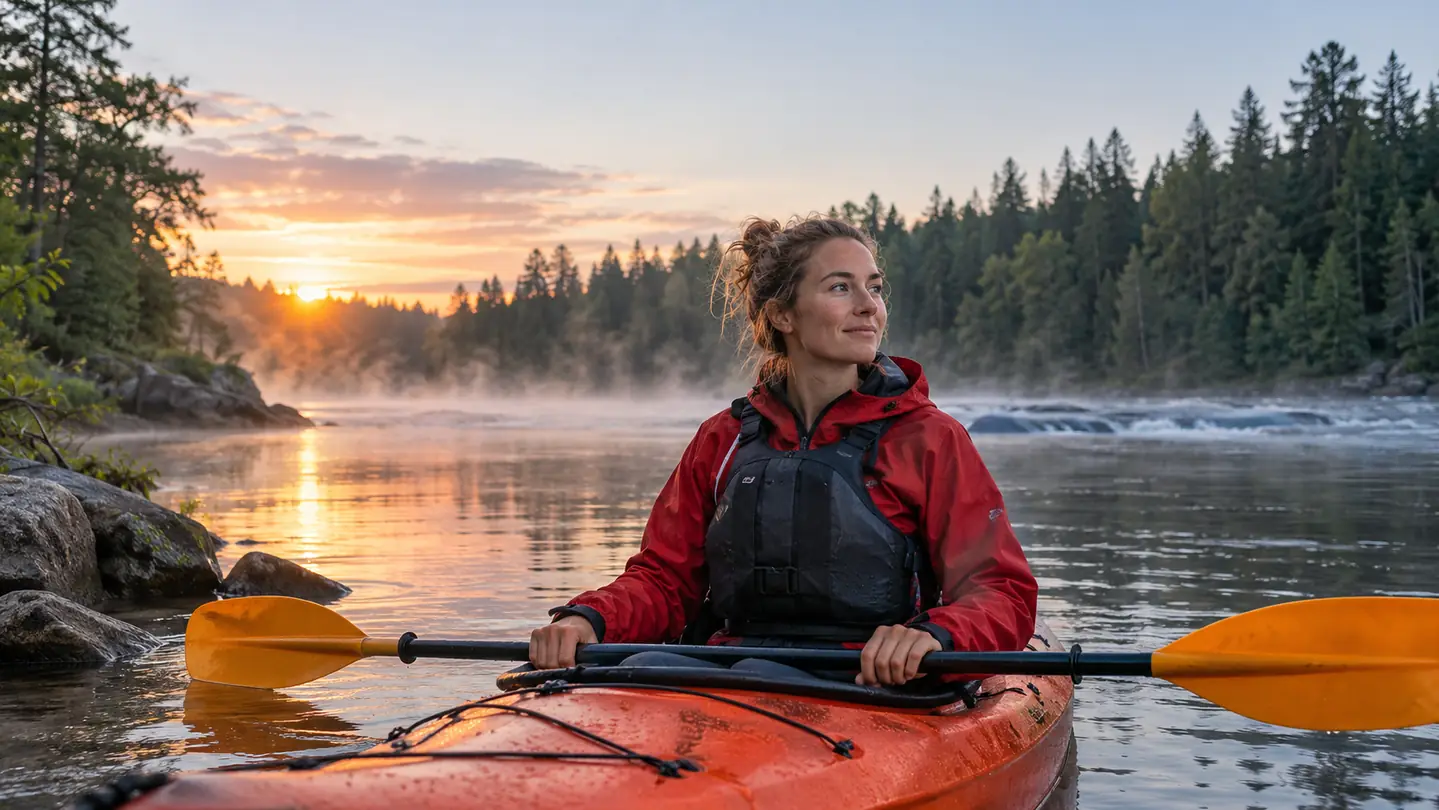
The first camera I took down the river died in a class II wave train on the Nantahala. Not a swim, not a flip. Just a wave that broke over the bow of my solo canoe while I was grinning at it, and a thirty second soak in a cheap dry bag that turned out to be about as waterproof as a paper grocery sack. I lost a body, a lens and a card full of heron shots I will never get back.
That was close to twenty years ago. Since then I have carried cameras on hundreds of river days, in my kayak and in my canoe, on everything from flatwater shuttle runs to class IV dam releases. What I have learned is that keeping gear dry is not one trick. It is a sequence of decisions, and if you get any one of them wrong, the water finds it. The case I use most now is a MEIJIA hard case, and this guide is the order I do things in.
The case that has survived every swim I have taken since 2019
MEIJIA's waterproof hard case is 11.65 x 8.74 x 4.06 inches, holds 3 liters, weighs 2.1 pounds and comes with a soft grip handle that clips to a thwart or deck rigging. It is what rides in front of me on every river day now.
Amazon Check Today's Price on Amazon →Step 1: Decide what gear is allowed on the water at all
Before you buy anything, before you pack anything, sit down and be honest about what you are willing to lose. Because you might. A hard case reduces the odds dramatically, and I will get to that, but the river is not a controlled environment and no product makes a camera indestructible.
My rule is simple. The body and one lens go in the case. Everything else, meaning spare batteries, a cloth, an extra card, goes in a second small container that also floats. My phone does not come out of the truck. My good tripod does not come on whitewater days, period. I carry a small clamp or a chest mount instead.
Karen and I shoot different things and pack differently as a result. She likes birds and works from the bank more than I do, so she carries a longer lens and leaves it in the boat more often. I like scenics and shooting from the boat itself, so I favor a wide angle and accept that I will be handling the camera in a spray zone. Decide which paddler you are before the gear conversation even starts.
Step 2: Choose a case that survives immersion, not just rain
There is a meaningful difference between water resistant and waterproof, and most paddlers find out which one they bought at the worst possible moment. A dry bag with a roll top is fine for a sleep system. It is not fine for a camera, because roll tops fail at the fold and a bag that gets pinned against a rock in a current will let water in through the fabric itself.
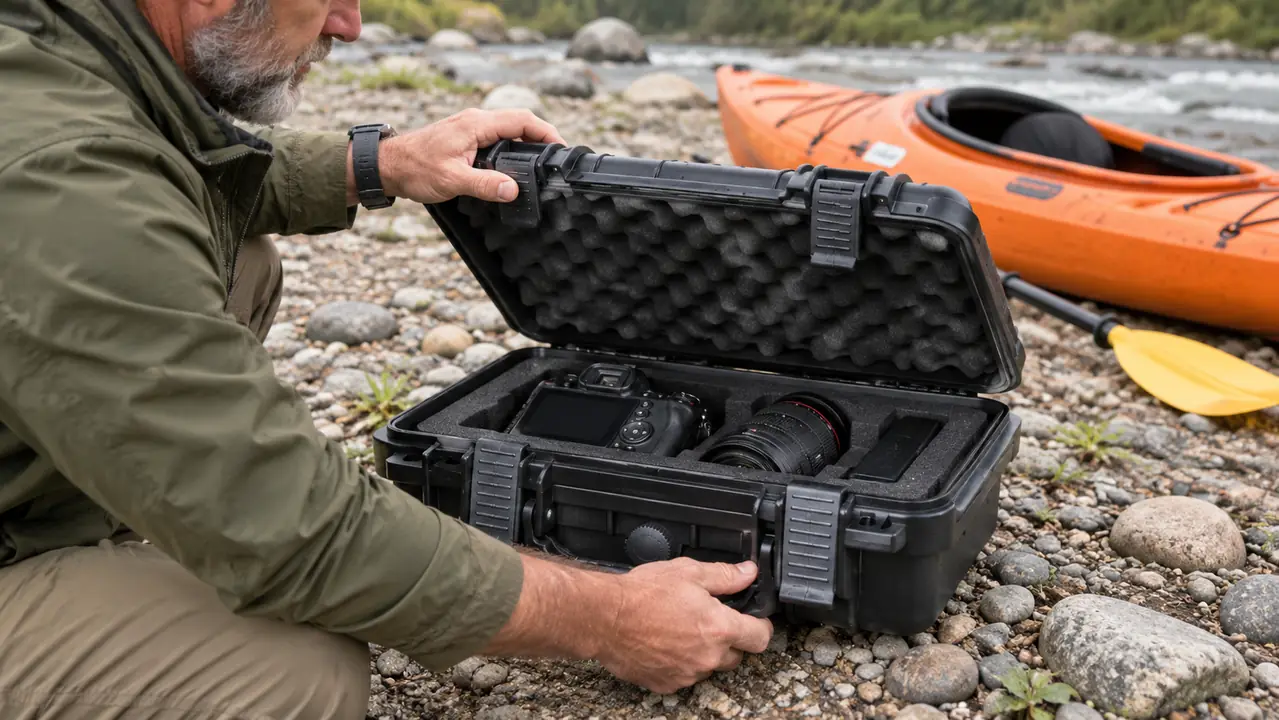
What you want is a hard shell. The MEIJIA case is polyethylene with a hard shell and a zipper closure, and the listing rates it as waterproof. The shell is what matters here. A soft bag deforms under pressure, and pressure is exactly what a river applies when your boat pins or your case gets stepped on in the shuttle truck. A rigid shell keeps its shape, keeps the foam against your gear, and keeps the seal closed.
Pay attention to size, too, because this is where people overbuy. The MEIJIA is 11.65 inches long, 8.74 wide and 4.06 high, 3 liters of capacity, and it weighs 2.1 pounds empty. That is a body and a lens with foam around them. It is not a full kit case, and if you try to make it one you will end up with no padding at the corners, which is the whole point of the case. I fit a mirrorless body with a compact zoom and a spare battery, and that is my river kit.
Step 3: Pack it so the foam is doing actual work
A hard case with loose gear rattling around inside it is barely better than a bucket. The protection comes from the foam holding the camera still, with no room to build momentum before it hits a wall.
Cut the foam so the body sits snug and you can just barely lift it out with two fingers. If it drops out when you turn the case over, the cut is too loose. If you have to pry it, the cut is too tight and you will crack a screen trying to get your camera out in a hurry on a moving eddy. Leave a finger notch at one end so you have something to grab.
One more thing on packing, and this is the part that has saved me twice. Put a desiccant pack in with the gear, and put a slip of paper with your name and phone number in there too. If the case ever comes out of the boat and floats off, the paper is the only thing that gets it back to you. I have watched a case go downstream and I have watched a landowner call a stranger two days later because of a scrap of paper.
Step 4: Rig it so the case cannot leave the boat
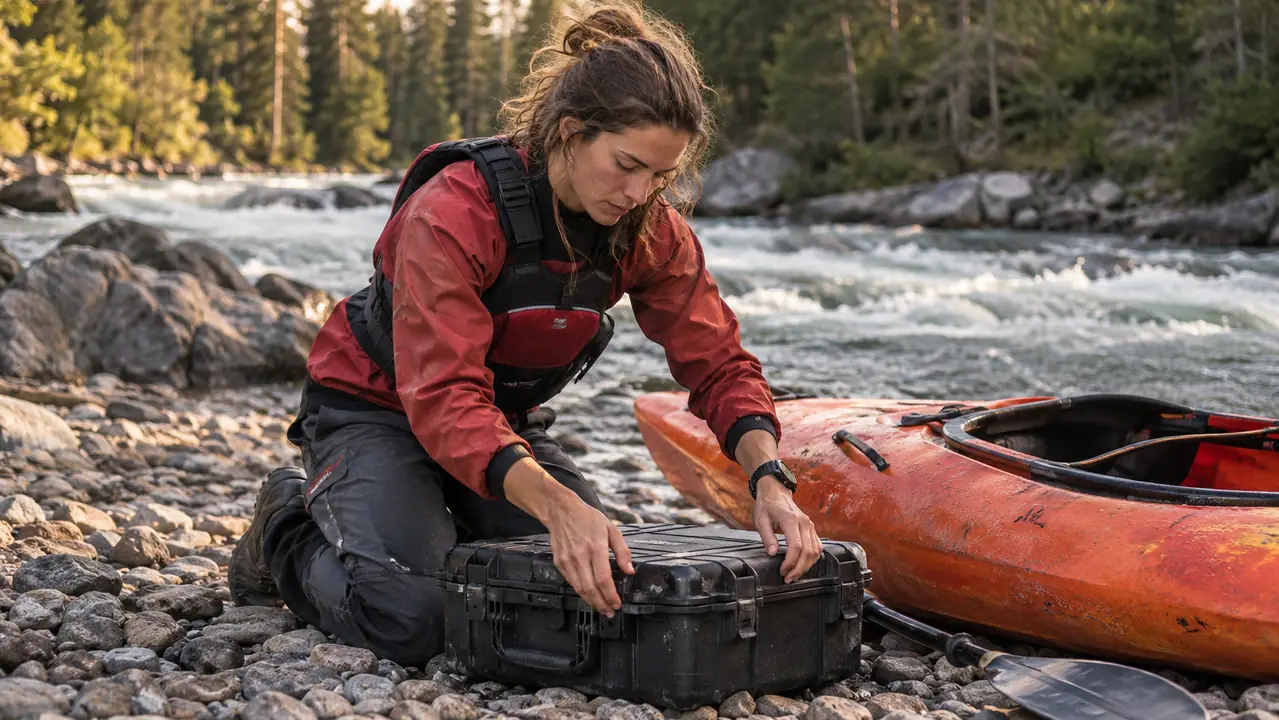
This is where I see beginners make their biggest mistake, and it has nothing to do with the case at all. They set a case on the floor of the kayak or under the seat, and then they swim, and then the case is gone. A floating case is a lost case if nobody can reach it.
The MEIJIA case has a soft grip handle, and that handle is the whole rigging system. Run a short loop of 3mm cord or a small carabiner through the handle and clip it to a thwart, a deck rigging point, or the grab loop of your bag. Short. Six to ten inches of slack, no more, so the case cannot swing out and pendulum against your leg on a roll.
Test the rig on land before you launch. Pick the boat up by the case handle. If the case comes free, or if the boat feels like it is tipping toward the case, you have a problem you can fix on the tailgate instead of in an eddy. I do this every single time and I have caught two failed carabiners that way, both of them old and one of them visibly cracked.
Where it rides matters, too. In my river runner it goes between my knees or just in front of the seat, low and centered. In the solo canoe it goes against the front thwart with a foam block behind it. Never on top of the deck. Never anywhere it can become a lever against your body during a swim.
Step 5: Handle the camera like the case is the only thing between you and a bad day
The case only protects the camera while the camera is inside it. This sounds obvious, and yet the way most river cameras die is during the thirty seconds they are out of the bag.
My habit: the camera comes out on an eddy, not in moving water. I pull into the eddy above the rapid, brace the boat against a rock or a bank if I can, and only then open the case. The strap goes around my neck before the camera leaves the foam, every time, no exceptions. If the water is pushy enough that I do not want to take a hand off my paddle, then I do not take the picture. I have missed a lot of shots that way and I have never once regretted it.
Getting back in is the reverse. Camera in the foam, lid closed, latched, case clipped back to the boat, and only then do I pick up the paddle. I have seen people try to do this one-handed while drifting toward a horizon line. Nothing good comes of that. If you are shooting from a bank instead, the case rides on the gravel beside you and the same routine applies on the way in.
The camera comes out on an eddy, not in moving water. If the water is pushy enough that I do not want to take a hand off my paddle, then I do not take the picture.
Once you get home, do not just set the case in the garage. Open it, pull the foam, and let everything air dry overnight if the boat got swum or the case took spray all day. Zipper closures do not like grit. Rinse the zipper track with fresh water, let it dry, and put a little care on it once a season. My first MEIJIA is going on several seasons of this routine and the zipper still runs clean.
What Else Helps
A hard case solves one problem well. It does not solve the rest of the day, and I would be doing you a disservice if I let you think the case alone keeps your gear alive.
Keep the case out of direct sun when you take a break. Polyethylene gets hot on a gravel bar in July, and heat is hard on batteries and harder on seals over time. I set mine in the shade of the boat or under a jacket. If you are on a multi-day trip, rotate batteries rather than leaving them in a hot case all afternoon.
Carry the case in a small dry bag or in a boat bag so a swim does not turn the handle into a snag point on a strainer. The case floats, which is good, but a floating case bobbing down a rapid is still a case you may never see again. A tether to the boat plus a bag around the whole rig is cheap insurance.
And learn to read the section you are shooting before you shoot it. Most of my best river photographs come from scouting a rapid on foot or from the eddy above it, not from the middle of it. Get out and walk the bank. That advice has cost me nothing and it has saved me more gear and more skin than any piece of equipment I own.
Finally, take a rescue course and practice with your boat loaded the way you actually paddle it. A dry case changes how your boat floats and how it handles a wet exit. Find that out in a pool or a warm eddy with an instructor, not on a cold spring runoff day when the water is forty degrees.
Who This Method Is For
This is for the paddler who wants a real camera on the river and is willing to accept that some shots are not worth taking. It suits class I to III river runners, canoeists, and anyone who does day trips and wants to come home with the card intact. It fits well for paddlers who shoot from the bank as much as from the boat.
It is not a system for multi-day expedition photography or for carrying a large telephoto. If that is your goal, you need a much larger case and probably a different carrying strategy entirely, and you should look at something sized for a full kit. The MEIJIA case is a river day case, and it is very good at that job in exactly the size it is.
One honest limitation. The zipper closure is the wear point. It has not failed on me, but I maintain it, and I would not treat it like a latch-down hard case on a multi-week trip. Rinse it, dry it, care for it. If you want something with a different closure design to compare, the MEIJIA against a Pelican 1200 comparison is worth reading before you buy.
Three liters, 2.1 pounds, one camera and lens, dry all day
The MEIJIA waterproof hard case is 11.65 x 8.74 x 4.06 inches with a polyethylene hard shell and a soft grip handle that clips to your boat. It is the case I reach for on every river day. Gear does not replace training and judgment, but the right case means you are not gambling your camera on a wave.
Amazon Check Today's Price on Amazon →