
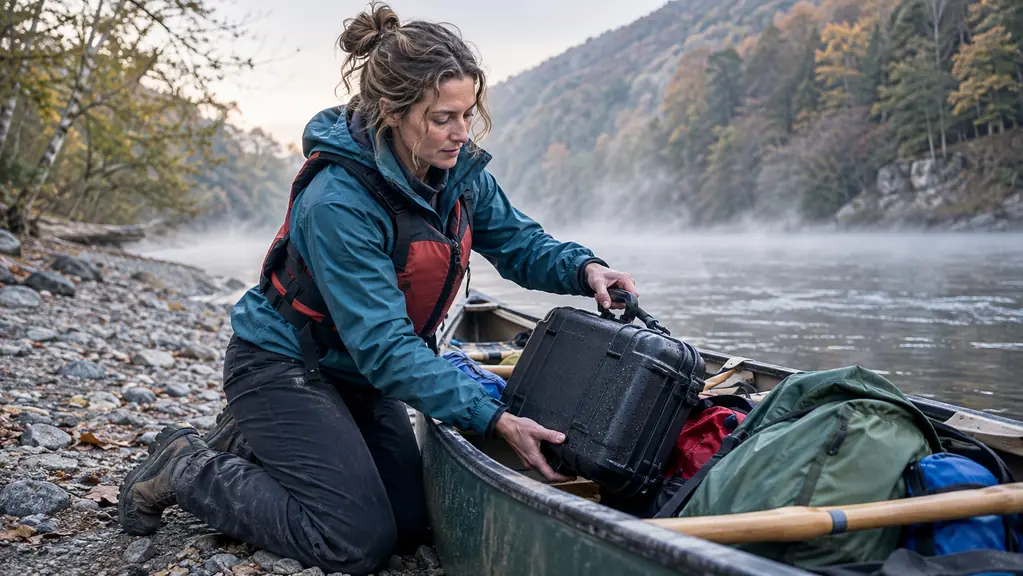
Every April at the put-in, somebody in my beginner clinic holds up a camera bag and asks what to put it in. I have answered that question the same way for years. Buy the smallest hard case that fits the gear, then pack it the same way every trip until your hands know where everything lives. Two cases come up in that conversation more than any other, the MEIJIA Portable All Weather Waterproof Protective Hard Case and the Pelican 1200. I own both. One rides in my solo canoe, the other stays in my truck between river days and goes in whichever boat I am teaching from.
The short answer is this. The MEIJIA is the case I recommend to a paddler who wants a hard shell, a waterproof rating and a low cost of entry, in a shape that drops into a hatch without rearranging the boat. The Pelican 1200 is the case I carry when the camera is the reason for the trip and I expect to spend real time in the water. Both are hard cases. They are built to different standards, and the spec sheets say so plainly before either one gets wet.
| MEIJIA Dry Case | Pelican 1200 | |
|---|---|---|
| Seal and closure | Rated waterproof, closure listed as a zipper | O-ring gasket held by two double-throw latches, rated submersible |
| Pressure valve | None listed in the specs | Automatic purge valve |
| Foam | Case only, no foam set listed | Pick N Pluck foam set on the foam version |
| Shape in a hatch | 11.65 x 8.74 x 4.06 inches, long and flat | Shorter and deeper |
| Weight carried | 2.1 pounds | Heavier empty, heavier still with foam |
| Cost to buy | Lower | Higher |
Where the MEIJIA Wins
The first thing I notice is the weight. The MEIJIA is listed at 2.1 pounds, in a polyethylene shell, at 11.65 by 8.74 by 4.06 inches, with 3 liters of stated capacity and a soft grip handle. On a day when I am hauling a boat, a paddle, a throw rope and a rescue vest up a bank, a camera box that weighs almost nothing earns its place. The Pelican is heavier before you put anything in it, and heavier still once the foam is in. Nothing dramatic, but weight in a boat works like weight in a pack. You notice it on the third portage, not the first. Two Julys ago I helped carry a student's boat up the long steep bank below the last rapid on a release day, and the difference between his gear pile and mine was not the boats. It was the accumulation of small heavy things, and a camera box is one of them. At 2.1 pounds the MEIJIA never enters that arithmetic. My Pelican with foam does, and I plan around it.
The second thing is the shape. Long and flat, so it slides under a thwart or lies along the bottom of a hatch instead of standing up and fighting the hull. In my solo canoe it sits behind the seat against the flotation bag and I forget it is there until I want it. At lunch I can pull it out, set it on a rock, open it and have the camera in my hand in the time it takes Karen to get the sandwiches out of the cooler. That is the whole job of a case on a river day, and the MEIJIA does that job without asking for attention. The numbers matter here more than they look on paper. 11.65 inches long and 4.06 inches tall is a long, low profile, and that profile is what lets it lie flat instead of wedging. I tried a deeper square box first, one I already had in the shop, and it stood up under the thwart and rolled every time I leaned the boat onto the truck rack. I gave up on it after two trips and went back to a soft bag for a month. A box that will not sit still in a boat is a box you stop bringing.
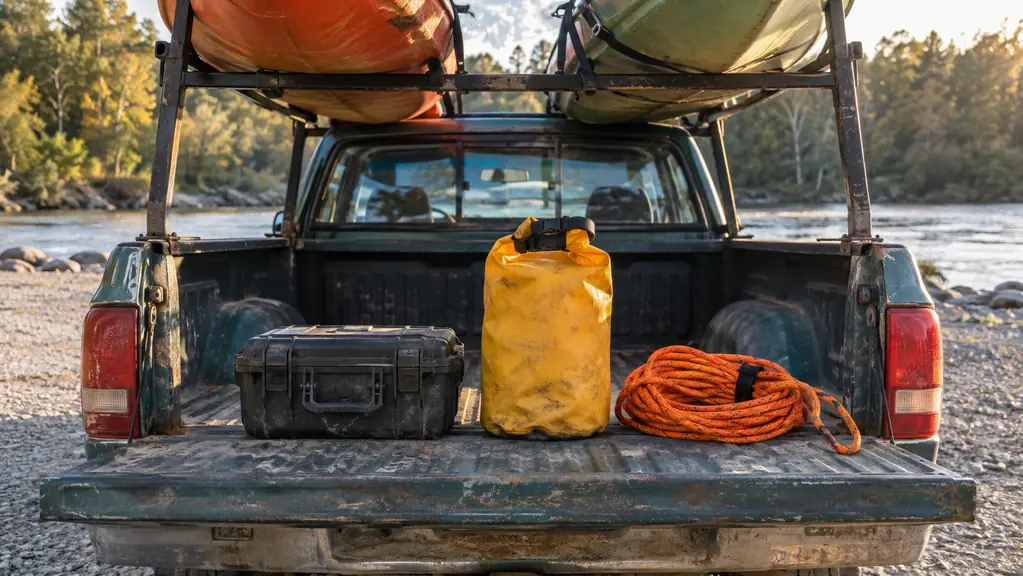
The handle deserves a mention, because the handle is usually the part that fails first on a cheap box. The MEIJIA has a soft grip handle, comfortable enough to carry one handed from the truck to the water with a camera, a spare battery and a lens cloth inside. It does not cut into your fingers when the case is loaded, which sounds like a small thing until you are walking it a quarter mile with a boat on your shoulder and a paddle in the other hand. It lives on the floor of the pickup under the two-boat rack most of the week, gets loaded on top of a dry bag, and comes out at the put-in with the rest of the gear. After a couple of seasons of that, it still closes the way it did on day one. I cannot tell you it will last a decade. I can tell you it has not given me a reason to replace it.
Then there is the cost of entry, which at today's price sits well under what the Pelican asks. That matters more than people admit. Plenty of the folks in my clinics are getting into whitewater with a borrowed boat and a camera they genuinely care about, and a hard case that costs less than a shuttle run of fuel actually gets used. An expensive box that stays in the truck protects nothing. What you give up for that lower cost is the next section, and I am not going to pretend otherwise.
Where the Pelican 1200 Wins
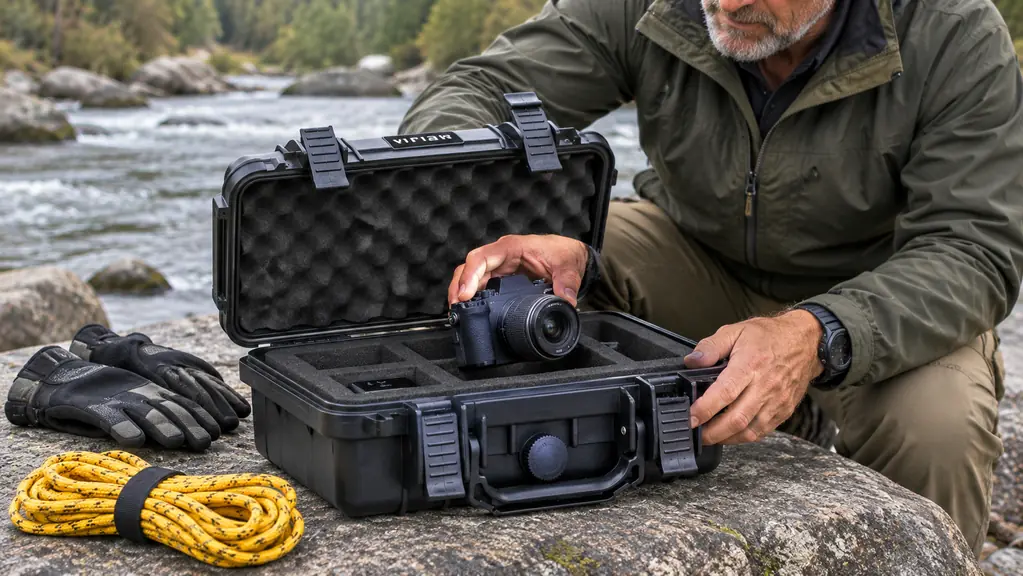
Here is where the two cases stop being the same class of tool. The MEIJIA spec sheet lists a zipper closure with a waterproof rating. The Pelican 1200 closes on an O-ring gasket compressed by two double-throw latches, and Pelican rates it submersible. A zipper and a squeezed gasket are not the same answer to the same question. Spray over the bow, rain on the bank, a wet throw rope dumped on top of the lid, the MEIJIA handles all of that and I have used it for exactly that. A swim where the case goes under and stays under is a different test, and it is the test the gasket was built for. I have run that test by accident twice. The one I remember was a spring release day three seasons back, a wave train with more push than it looked from the eddy above it, and I went over and stayed under long enough to lose track of which way was up before I rolled. The Pelican was strapped in the boat with the camera inside and it came up dry. I cannot tell you the MEIJIA would have failed that day. I can tell you I would not have chosen to find out with a camera I care about inside.
Second is the automatic purge valve, one of those features you never think about until the day it saves you a wrestling match on the bank. Load a sealed case in a cold boat at dawn, run it in the sun on a tailgate at lunch, then cool it again in river water, and a case without a valve can build a pressure difference that leaves the latches stubborn and the gasket working harder than it should. Third is foam. The Pelican 1200 comes in a version with a Pick N Pluck foam set you shape around a lens and a body, which is the difference between a camera riding loose in a box and a camera held still. The MEIJIA listing is for the case itself, with no foam set listed. You can cut your own foam, and I have, but the factory block is faster and neater.
I have never tested a depth rating on purpose. I have tested plenty of them by accident.
What Neither Case Will Do for You
Neither case will teach you to roll, and neither one keeps a camera dry if you leave it open on a rock while you walk upstream to scout. I have watched that happen and I have watched the case get blamed for it. A hard case is one layer and only one. Inside it, on any run where I expect to be upside down, the camera goes in a small dry bag, the dry bag goes in the case, and the whole thing gets tethered to a thwart so it stays with the boat through a yard sale. That is not a knock on either product. It is just how the sport works. I have done the other careless thing too, the one I warn students about, which is setting the open case on the bank at the top of a rapid and walking off to scout the line. The lid catches a gust, or another paddler sets a helmet down on top of it, or the whole thing tips and the contents spill onto gravel. Nothing about a hard shell prevents any of that. What prevents it is a rule: the case closes before I stand up. Every time, no exceptions, even when I am only stepping five feet away to look at the entrance. Two seasons of following that rule has cost me maybe ten seconds a trip and saved me two cameras.
The other thing I tell every clinic is that no piece of gear makes you safe. A case protects a camera. It does not protect you. Judgment, a clean line, a helmet that actually fits, a rescue rope you know how to throw, and the discipline to walk a rapid you do not like the look of are what keep a day from going wrong. On the helmet question, the one I see most often in beginner boats is a general water sports helmet, which is fine for easy water, and anyone running class IV or harder should be looking at a whitewater-specific helmet instead. Buy the box for the camera and buy the training for yourself, and do not confuse the two.
The Case I Hand to Most Students
Hard shell, 2.1 pounds, listed waterproof, 3 liters of space, and small enough to live in the boat instead of the truck. If your camera rides with you on class II and III, start here and spend the savings on a better PFD.
Amazon Check Today's Price on Amazon →Who Should Buy Which
Buy the MEIJIA if you paddle class II and III, want a hard shell and a waterproof rating, and want the camera in the boat rather than locked in the truck. It is the case I recommend to the person in my clinic carrying a compact camera or a small mirrorless body, who is not planning to swim with it, and who would rather put the difference toward a rescue course. It fits a hatch, it weighs 2.1 pounds, and at today's price it is easy to say yes to. I keep mine in the canoe on dam-release days when I want bird photographs between rapids, and it has been wet, dropped on rock and sat on by a wet paddler in a spray jacket, and the camera inside has stayed dry.
Buy the Pelican 1200 if the camera is why you came, if your runs include sections where being upside down is expected rather than accidental, or if you shoot from the bank in weather and need to know the box is submersible. The gasket, the valve and the foam set are worth the extra weight and the extra cost to the right person. What I would not do is buy the Pelican and then pack it carelessly. An expensive case with a loose camera rattling around inside it is still a loose camera. Whatever you choose, label it, tether it, and open and close it once on the bank before you put it in the boat.
Match the Case to the Water You Actually Paddle
Most paddlers on class II and III never need a submersible box. They need a light hard case that fits the boat and gets used every trip. That is the case above, and it is the one I paddle with.
Amazon Check Today's Price on Amazon →