
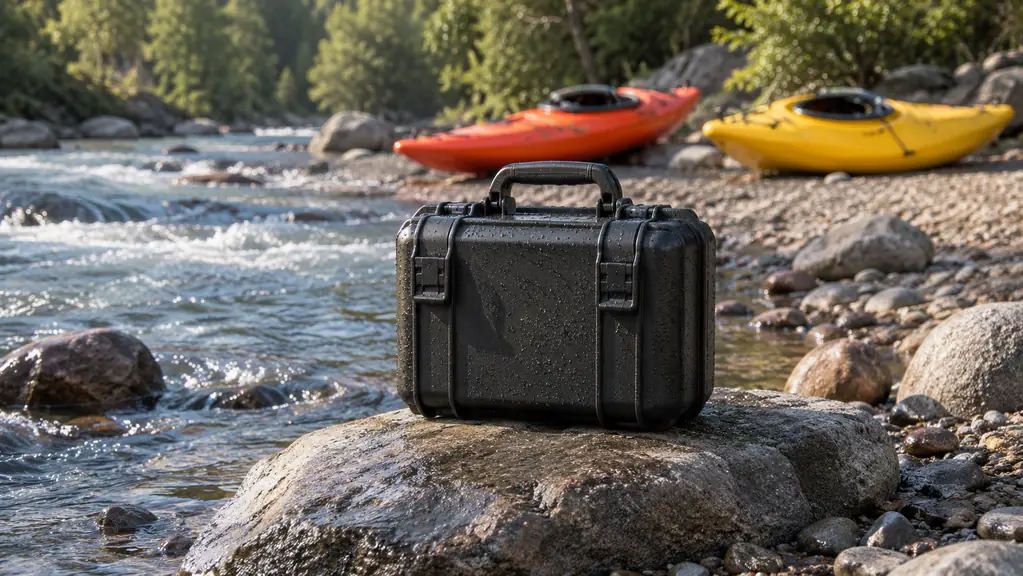
I have flipped a loaded boat in the Nantahala gorge, and I have watched a soft dry bag burp a cup of river water onto a friend's camera on the Ocoee. Neither of those days ended in a ruined photograph, but both changed what I am willing to carry on the water. When I started shooting herons and warblers from the bank between clinics, I needed a box that would survive a swim and a drop onto rock. I bought the MEIJIA Portable All Weather Waterproof Protective Hard Case last spring. It has ridden in my solo canoe, behind the seat of my river runner, and in the bed of my pickup ever since. This is what several months of that has taught me.
I am 61. I have been paddling whitewater for about 30 years, and I teach weekend beginner clinics out of western North Carolina from April into September. My wife Karen paddles class II and III with me and runs shuttle on the harder days. What follows is not a lab test. It is a working instructor's account of a small hard case that gets treated badly, plus the parts of it I would change.
The Quick Verdict
A genuinely tough little hard case that has survived a full river season without a drop of water inside. The zipper is a maintenance obligation, and 3 liters fills up faster than you think.
Amazon Check Today's Price →The Box That Rode Every Shuttle Run This Spring
Hard shell, waterproof rating, 2.1 pounds, and small enough to live on the boat. It is the one piece of my camera kit I stopped worrying about.
Amazon Check Today's Price on Amazon →How I've Used It
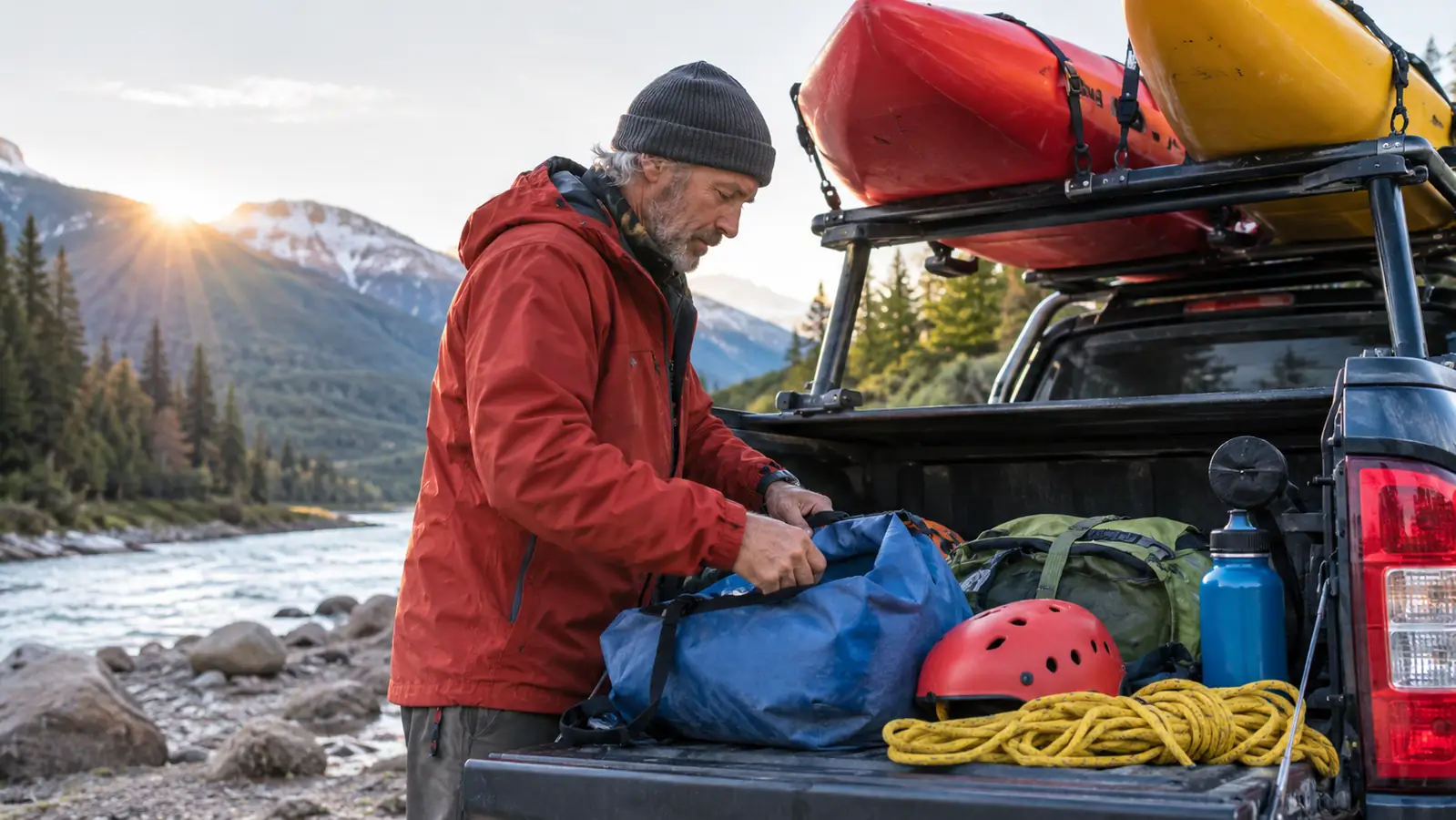
From late March through July the case lived in one of three places: under the bow deck of my solo canoe, tucked behind the seat of my river runner, or on the passenger floor of the truck on shuttle. It has been on the water for dam release days on the Ocoee, on two overnight trips on the Nantahala, and on more beginner clinics than I can count, where it mostly sat on the gravel while I talked a nervous student through a wet exit. That last part matters more than it sounds. A case that lives strapped on a boat is the easy test. A case that gets opened and closed forty times in a day on a gravel bar, by wet hands, in the rain, is the real one.
Twice I put it in the water on purpose. Once in an eddy above the Nantahala falls, and once in a deep pool during a rescue session, because I wanted to see how a hard case behaves when a swimmer is holding it rather than wearing it. Both times it came up with the shell streaming water and the inside bone dry. I have also dropped it, loaded, from roughly waist height onto the Ocoee takeout ramp, which is about as close to concrete as a river gets. It bounced, skidded a foot, and the zipper still ran.
The first real test came on the second Saturday in April, on a dam release day at the Ocoee. Water was running cold enough that my hands ached inside neoprene gloves, and I was teaching four beginners the wet exit in a flat eddy below the put in. My routine on those mornings is to demo the exit, climb back in soaking wet, and shoot a few frames of each student's first attempt so they can see their own body position afterward. That means the case gets opened with dripping hands, closed with dripping hands, and set down on wet gravel roughly every four minutes for two hours. It sat in a shallow puddle for most of the second hour because I stopped noticing where I had put it. At lunch I opened it to swap a battery and the inside was dry, and the camera had been sitting in that puddle the whole morning. That was the day I stopped double bagging it.
What the Hard Shell Actually Does
The MEIJIA listing says polyethylene, and polyethylene is what the shell feels like: stiff, a little slippery, and inclined to slide down a wet canoe deck rather than grip it. The case weighs 2.1 pounds, light enough that I stopped thinking of it as cargo somewhere around the second week. It measures 11.65 inches long, 8.74 inches wide, and 4.06 inches high, which is roughly the footprint of a thick paperback. The maker rates it waterproof, and five months of my use does not argue with that rating.
The handle is a soft grip, and it is the part I use most. When you are carrying a boat on one shoulder and a paddle in the other hand, a handle you can hook with two fingers matters. It has not split, stretched, or gone slick with sunscreen, which is more than I can say for the webbing handles on two soft dry bags I own. The surface takes a beating without showing it much. River mud rinses off. Scrapes from the takeout ramp are there if you look for them, and they are cosmetic.
The slipperiness is worth its own paragraph, because it is the one shell behavior that changed how I rig the boat. On a flat, wet canoe deck the case will walk toward the low side if you leave it loose. Before I started setting it on a scrap of rubberized shelf liner, it slid about six inches during a ferrying drill on the Nantahala and came to rest against the gunwale, which is where the water comes over first in a big wave train. Nothing got wet, but I stopped trusting it to sit still. The liner lives in the bottom of the case now, takes up no room I miss, and the problem has not repeated since. If your boat has a flat deck and you plan to leave the case loose, plan on the liner.
What Fits, and What Stays Home
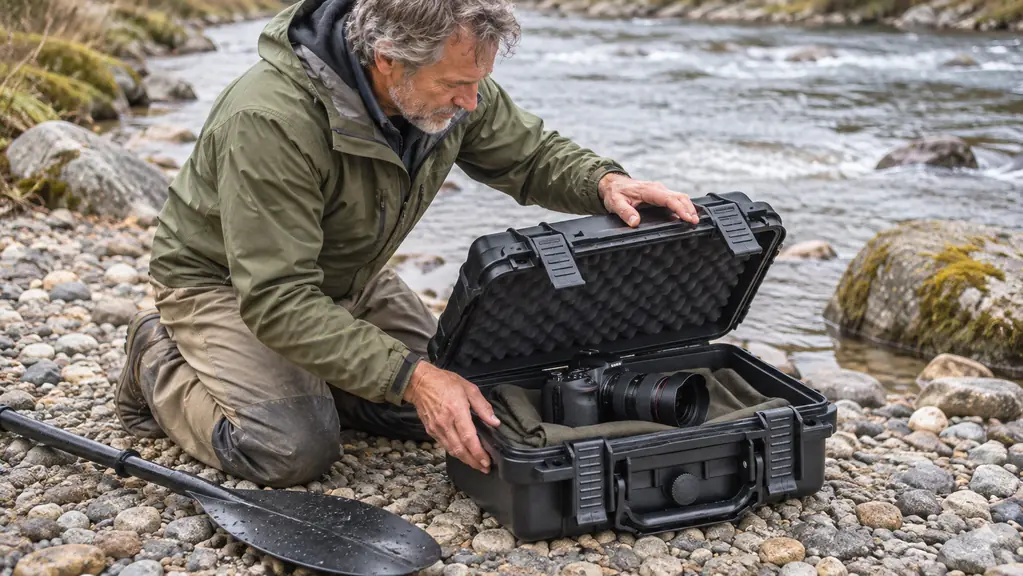
Three liters sounds like more room than it is. My mirrorless body with a compact zoom mounted fits with the lens hood reversed, alongside two spare batteries, a card wallet, and a folded microfiber cloth. It closes without forcing. Add a second lens and you are already negotiating. Add a full frame body with a fast zoom and you have left the case behind entirely. A small tripod does not go in. Neither does a rain shell or a lunch. This is a camera and electronics box, not a gear box.
On clinic days the case also carries my phone, my truck key, and a written shuttle schedule. That is deliberate. A hard box floating free of a swamped boat is a great deal easier to find than a phone in a mesh pocket, and I have watched students learn that lesson the hard way on the Nantahala. I fold a microfiber cloth under the camera body, because cushioning is the part the case does not do for me.
I tried to make it hold more than it wants to, and I want to be specific about how that failed. In May I added a small flash unit and a spare lens in two padded pouches, thinking I could shoot portraits of students at the takeout. It closed, but only just, and the lid sat under tension for the entire run. When I opened it at the end of the day the flash had a scuff across the top of the shoe, and I had spent the whole afternoon thinking about the lid instead of the students. I took both out that evening and have not put them back. The right number is one body, one compact lens mounted, batteries, cards, and a cloth. Anything past that and you are asking a 3 liter box to be a 6 liter box, and it will tell you no by pressing on your lens cap.
It has been dunked twice on purpose, dropped onto the takeout ramp, and rained on in a truck bed for five months. Nothing inside it has ever been wet.
The Zipper Is the Whole Story
Every dry case lives or dies on its closure, and this one closes with a zipper. That is the honest tradeoff in the design. A zipper gives you a wide opening that is easy to load with cold, stiff hands, and it does not require the two-handed latch wrestling that a hard latch case demands when your fingers are numb in April runoff. It also depends on a clean sealing surface. Sand in the teeth is the enemy, and there is sand on every riverbank in western North Carolina. I rinse and dry the track when I get home, and I do not drag the case through gravel by the zipper end. If you know you will not do those two things, buy a latch case instead.
Once a week during the season I open it up, wipe the track with a damp cloth, and let it air dry before closing it again. That is about three minutes of my life per week. In exchange, the case has not leaked. What I would tell a buyer is that the zipper is not a defect, it is a maintenance obligation. Treat it the way you treat the gasket on a dry top and it does its job.
The one time I let the track go, I paid for it in a parking lot. It was the fourth of July weekend, we had run the Nantahala twice in two days, and I left the case closed and full of sand in the truck overnight because I was tired and the cooler needed unloading. Next morning the pull moved about an inch and stopped. I did not force it. I carried the case to the tailgate, opened the lid against the zipper's resistance as far as it would go without strain, and flushed the track with a bottle of drinking water, then picked the grit out with a toothbrush I keep in the glove box for exactly this. It took eight minutes. The zipper ran clean afterward and the inside was still dry, because the resistance was grit, not a failed seal. Eight minutes and a toothbrush is a cheap lesson, and now the brush lives in the case instead of the glove box.
Five Months In, What Held Up
By the end of July the case had a scuffed corner, a faint set of scratches along one long side, and a handle that still looked new. The zipper pulls were straight. The shell had not cracked, crazed, or gone soft in the sun, and it spent a great deal of time in the sun on the back deck of a canoe. Those are low bars, I know, but I have owned soft bags that failed every one of them inside a single season.
The one behavior worth mentioning is that the case can be stiff to open after it sits in cold water and then in a hot truck bed. It is not stuck and it is not broken, and it has never leaked afterward. It just takes a second pull. I have stopped noticing it. A buyer should know it happens so it does not surprise them in a parking lot.
I keep a short log of gear problems in the back of my clinic notebook, mostly so I stop repeating whatever caused them. Between the last week of March and the end of July there are four entries next to this case. Two are the sand and the stiffness already covered above. One is a scuffed corner from the drop on the Ocoee ramp. The fourth says only this: shot 214 frames on the Chattooga trip, card and battery changes done on a wet rock, no water, no fog inside the lid. That last part is the one I care about. A sealed box that traps humid air will fog a lens the moment you open it in cool morning shade, and this one has not done that to me yet. On the two hottest afternoons I opened it slowly and let it sit a minute before pulling the camera out, which is the same habit I would keep with any hard case.
Would I buy it again? Yes, for the way I use it, and I would buy it faster if I shot a smaller camera. If I were carrying a full frame kit on the river I would be looking at a larger box with a different closure and I would accept the extra weight to get it. As it stands, the MEIJIA case has done exactly what I bought it to do, which is to keep a camera alive through a season of bad decisions about water.
What I Liked
- Hard polyethylene shell shrugged off a loaded drop onto the takeout ramp
- Waterproof rating held through two deliberate dunkings with a dry interior both times
- 2.1 pounds with a soft grip handle that is easy to hook with two cold fingers
- 3 liters takes a mirrorless body with a compact zoom, batteries, cards, and a cloth
- Scuffs and scratches stayed cosmetic through five months of river use
Where It Falls Short
- Zipper closure needs a clean track and weekly attention, or it becomes the weak point
- Can be stiff to open after cold water followed by a hot truck bed
- 3 liters is small for a full frame camera and leaves no room for a second lens
- The handle is for carrying, not clipping, so there is no dedicated attachment point for a deck rig
- No padding of its own, so you supply a cloth under the camera
Who This Is For
This case is for the paddler who wants one hard, waterproof box for a small camera, a phone, and a set of keys, and who is willing to spend three minutes a week looking after a zipper. It suits instructors, photographers who shoot from the bank, and anyone who has already lost something to a soft bag and would rather not repeat it. If your kit is small and your standards for dry are high, the MEIJIA case is a sensible buy at 3 liters.
Who Should Skip It
Skip it if you shoot a full frame body with fast glass, if you need a case with a dedicated attachment point to lash onto a deck rig, or if you know in your heart that you will never clean a zipper track. A latch case with a pressure relief valve, or a soft dry bag inside a hard box, will serve those paddlers better. And no case makes up for skipped rescue practice or a poor read on a rapid. The box keeps your camera dry. It does not keep you safe. Gear does not replace training and judgment, on any river, on any day.
Five Months, Two Dunkings, Nothing Wet Inside
Hard shell, waterproof rating, 2.1 pounds. Small enough to ride on the boat and tough enough to survive the takeout ramp.
Amazon Check Current Price on Amazon →