

The most common helmet problem I see at a put-in is not a cheap helmet. It is a decent helmet sitting too high and too loose on a paddler who is ten minutes from cold class III water. I teach weekend beginner clinics on the Ocoee and the Nantahala, and every spring I watch the same scene play out: somebody pulls a helmet out of the truck, drops it on, pats the top, and calls it done. Then they swim a rapid, and the helmet goes one way and they go the other. A helmet that comes off in a swim is not protecting anything.
Fit is the part of helmet shopping nobody photographs. It does not make a good product image and it does not fit neatly in a bullet list. But it is the difference between a helmet that does its job and a helmet that is just along for the ride. What follows is the process I walk students through, using the Vihir adult water sports helmet as the working example. The Vihir is a general water sports helmet with a stated size range of 59 to 63 cm, an ABS outer shell, an expanded polystyrene liner, and ear pads. That range covers most adult heads, and the ear coverage is the feature beginners ask about first, usually because they have already had an ear opened up on a rock.
Measure the head before you pick a size, not after
The Vihir adult water sports helmet comes in one size, L, covering 59 to 63 cm. Get your number first, then go look at the fit range and the current price on the listing.
Amazon Check the Vihir helmet on Amazon →Step 1: Measure Your Head the Way a Shop Would
You need a soft tape measure and a mirror. Not a ruler, not a hat size, and definitely not the label inside a ball cap. Run the tape around your head about an inch above your eyebrows, level all the way around, snug but not tight. The tape should cross the widest part of the back of your skull. Read the number in centimeters and write it down.
Do it three times. I am serious about that part. Heads are not perfectly round and a tape slips. If you get 60 twice and 62 once, you are probably around 61 and the third reading caught some hair or a crooked tape. If you get 58 and then 63, have somebody help you measure again. Half a centimeter of error matters less than you would think in the middle of a size range, and more than you would think at the very edge of one.
Two things throw the measurement off. Long hair that you wear up on the river should be up while you measure, because that is the head the helmet is actually going on. And measure in the afternoon if you can. Nobody's head is identical at seven in the morning and four in the afternoon, and the put-in is usually later in the day anyway. Write the number on a piece of tape and stick it to the dash of the truck if you have to. You will not remember it once you are standing in a shop.
Step 2: Match the Number to the Range, Then Look Inside the Shell
The Vihir helmet is listed as size L, 59 to 63 cm. If your measurement lands between 60 and 62, you are in the middle of that range and the helmet has room to be adjusted to you. If you measure 59 or 63, you are at the edge, and edge fits are where people get into trouble. A 63 cm head at the top of a range can work, but expect a snugger starting point and less margin for error. A 58 cm head does not belong in a 59 to 63 cm shell, no matter how much padding gets added to it.
While the helmet is in your hands, look at what is actually inside it. The Vihir has an ABS outer shell and an expanded polystyrene liner, which is the same general construction you find in most water sports and bike helmets. That liner is the part that absorbs impact, and it is also the part that has to contact your skull evenly. Press your thumbs around the inside in a slow circle. You want continuous contact. You do not want a spot where the liner floats a half inch off your head while another spot digs in above your ear.
Check the shell against what the listing tells you: about 10 by 8 by 8 inches, and 420 grams. That weight is reasonable for a helmet with ear coverage, and it is a number worth knowing because you will feel it by hour four on the river. A helmet that fits correctly carries its weight across the whole crown. A helmet that is too big hangs off the back of your head and puts that 420 grams on your neck all day, and your neck will bring it up around lunchtime.
Step 3: Run the Three Dry-Land Fit Checks
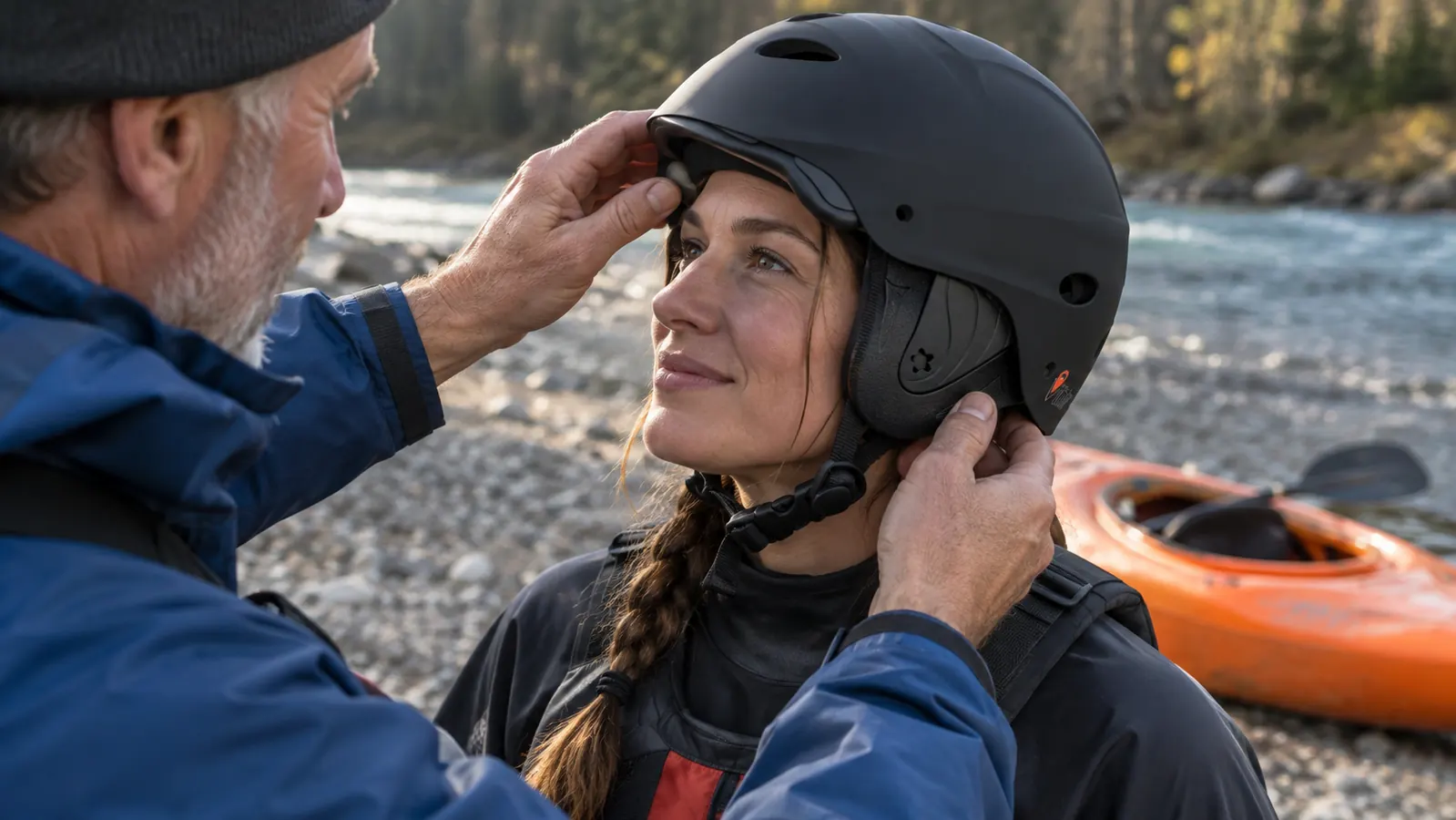
Put the helmet on and look at where the front edge sits before you do anything else. It should come down to roughly two fingers above your eyebrows, low enough that your forehead is covered down to the hairline. If you can slide your palm flat between the front edge and your forehead, the helmet is riding too high, and that is exactly the position where a rock finds the part of your skull you meant to protect.
Now shake it out. Turn your head firmly side to side, then nod up and down. The shell should move with your scalp, not slide across it. A little movement of the skin under the edge is normal. A helmet that shifts a visible half inch in any direction is too big, full stop, and no amount of fussing will fix a shell that is the wrong size for the head inside it.
Last check, and this is the one people skip. With the helmet on, reach under the front edge and press up and back, the way moving water pushes a helmet if you drop into a hole. It should not roll back off your forehead. Then press up from the rear edge, which is the direction a head-first swim pushes it. It should not rock forward over your eyes. The Vihir ear pads should be sitting centered over your ears through all of this, covering the ear without folding the top of it over. Then talk to somebody. The pads exist to keep rock and gravel off your ears, and the listing is clear that they should not affect hearing. If you suddenly cannot hear the person next to you, that helmet is sitting wrong or it is the wrong size.
Step 4: Test the Fit in the Water, Not in the Driveway
A helmet that fits in a parking lot can still be wrong on the river, because everything changes when it gets wet. Hair compresses. Liners and pads take on a little water and give. Cold water tightens your neck and changes how you hold your head. The real test happens at the put-in, in an eddy, before you commit to the run.
Wade in, duck your head, and let the helmet soak through. Then repeat the shake test and the roll-back test. If it moved on dry land it will move more when wet, so anything marginal becomes obvious here. If you are somewhere safe to do it, do a wet exit and a short swim. I have students swim across an eddy with the helmet on before we ever run a rapid. It takes thirty seconds and it tells you more than an hour of standing around on gravel.
Pay attention to the vents while you are in there. The Vihir has 11 vents in total, with channels up front feeding the ventilation, and on a hot July day on the Nantahala you will be glad for every one of them. In April runoff those same vents move cold water across your scalp, which is a real consideration on a long swim. That is not a reason to want a helmet with less ventilation. It is a reason to dress for the water temperature and get out of it quickly. Comfort is part of why people keep a helmet on all day instead of shoving it into the boat at the first eddy.
Step 5: Re-Check Every Run and Know When Fit Means a Different Helmet
Fit drifts. Hair gets cut. A helmet gets loaned out for a lake day and comes back set up for somebody else. I check mine at the put-in on every single run and it takes about ten seconds: front edge two fingers above the eyebrows, shake test, roll-back test, ear pads centered. That is the whole routine. Say it out loud the first few times and it becomes automatic by the end of the season.
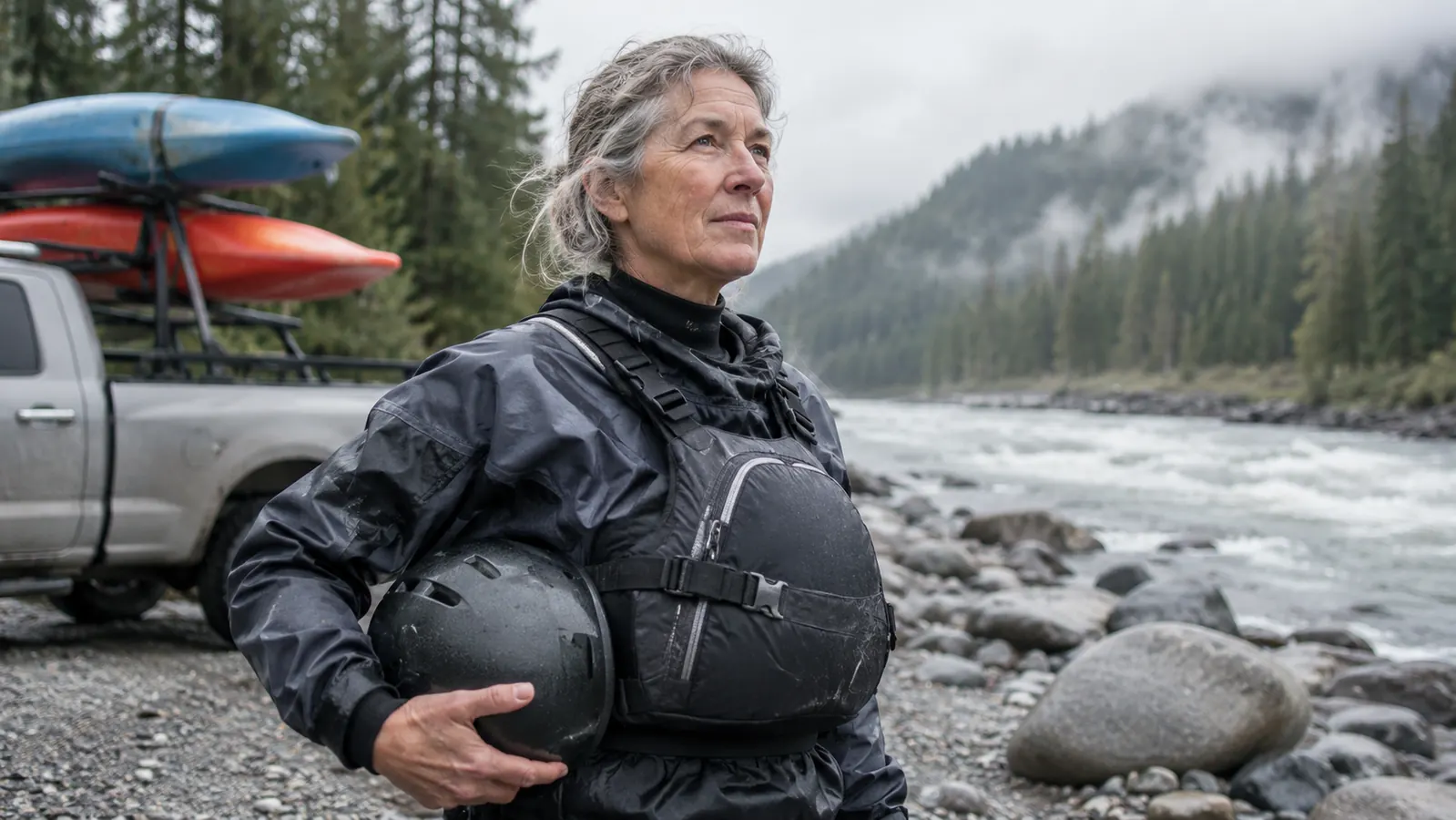
The other thing I tell students is that fit is not the same thing as suitability. The Vihir is a general water sports helmet, built for kayaking and similar use, and it has been a good helmet for me on class II and III days, for teaching, and for flatwater photography trips where I am more worried about the gravel bar than the rapid. It is not a whitewater-specific helmet and I will not pretend otherwise. If you are running class IV and harder, or spending your season in rocky creeks where the consequence of a head impact goes way up, go buy a helmet designed for that job. That is not a knock on this one. It is knowing what you bought and matching it to the water you actually paddle.
None of this replaces training. A well-fitted helmet protects your head from some of what the river can do to it. It does not teach you to brace, it does not teach you to tuck, and it does not turn a bad line into a good one. Take a clinic. Practice your wet exits until they are boring. Learn to read a rapid before you run it. The helmet is the last line of defense, and it should be the least interesting piece of gear you own, because the whole point is that it quietly does its job while you think about everything else. The Vihir carries a one-year warranty, which says something about how the maker stands behind it, but the best thing you can do for its lifespan is keep it out of a hot truck bed and rinse it in fresh water after a day on the river.
What Else Helps
Two other pieces of gear matter as much as the helmet and neither one is optional. A properly fitted PFD, worn and fastened, not riding loose in the bottom of the boat. And a boat you can wet exit from without stopping to think about it. I will not put a student on the water with a helmet and no PFD, and I will not put one on moving water who has not practiced a wet exit in a pool or a calm eddy first.
Beyond that: dress for the water temperature rather than the air temperature. Cold spring runoff on the Ocoee humbles a paddler in shorts and a t-shirt, and a long swim in cold water narrows your margin fast. Carry a throw rope if you are leading a group. Scout the rapids you have not run before. And when you stop to photograph birds or the light on the water on the way home, which is how I spend most of my evenings, keep the helmet on. Some of the head knocks I have seen in thirty years happened in places nobody called a rapid: the gravel bar, the truck bed, the slick rock at the takeout. Wear it, check the fit, and let it do the one job it has.
If I can slide my palm flat between the front edge and your forehead, that helmet is decoration. Two fingers above the eyebrows, or start over.
Get the measurement, then get the helmet that matches it
One size, L, 59 to 63 cm, ABS shell over an expanded polystyrene liner, with ear coverage and 11 vents. Check the fit range against your number before you order.
Amazon See the Vihir helmet listing on Amazon →