
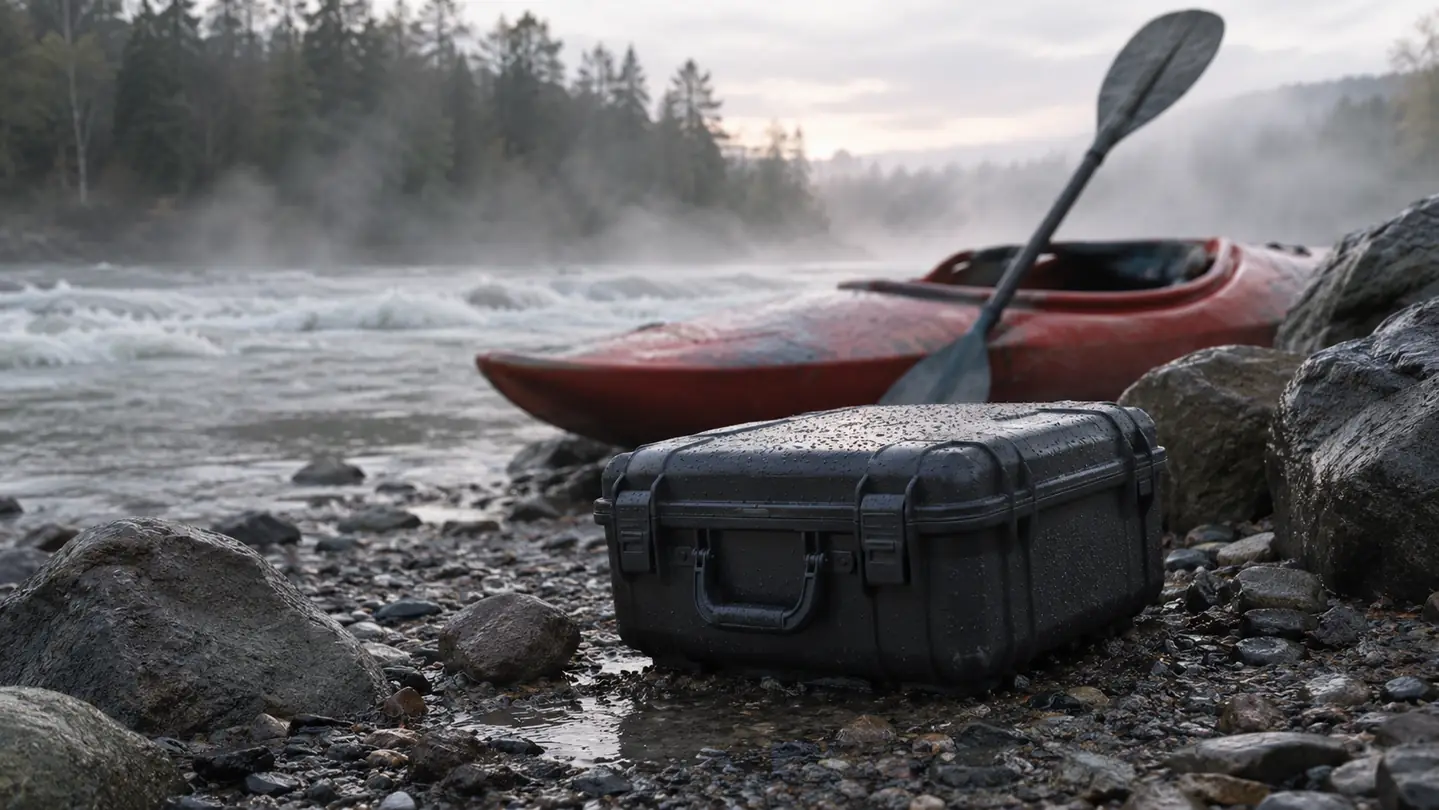
Twenty-nine years of whitewater and the lesson that made me fussy about dry storage was not a big swim. It was a slow leak. A cheap roll top bag, a damp corner on a lens cloth, four hours of cold dam release water working its way in a teaspoon at a time. Nothing was ruined. Everything was damp. Since then I have cared a great deal about what my camera rides in, which is how the MEIJIA hard case ended up in the back of my truck for a full season before I sat down to write a word about it.
There are plenty of pages that will tell you this case is wonderful. This is not one of them. This is the page that tells you where it falls short, what it will not do, and which paddlers should walk right past it. The shell on the MEIJIA case is honest and the seal is honest. The honest limitation is that a zipper case is not a latch case. If that sentence means nothing to you yet, it will by the end.
For context on where the opinion comes from: I have paddled whitewater for about thirty years, I teach weekend beginner clinics in spring and summer, and I shoot birds and mountain scenery from the boat and from the bank. My home water is cold spring runoff and dam release days, class II to IV. I am not gentle with gear, but I am careful with it in specific ways, and one of those ways is keeping river water away from a camera.
The Quick Verdict
A tough, genuinely dry little box for a small camera kit, a phone and truck keys. Buy it for the polyethylene shell, not for the zipper, and do not expect to lash it to a boat.
Amazon Check Today's Price →If a hard shell matters more to you than a latch, start here
The MEIJIA case is a three liter hard shell with a zipper seal, a soft grip handle and a listed weight of 2.1 pounds. Check the current price and the interior dimensions against your own camera body before you commit.
Amazon Check Today's Price on Amazon →How I've Used It
The camera rides in the hull on flat sections, in the truck bed on shuttle, and in whatever case I trust when I am standing on the bank waiting for a heron to do something interesting. That is a harder life than it sounds. The case gets set down in wet gravel, sat on, stacked under a boat, and opened with cold hands while the group waits on me. Over one spring and summer of clinics and personal days, the MEIJIA case did all of that without complaint and without a drop of water inside.
The first Saturday it went out with me was a clinic day in late March, forty one degrees with the release running, and I made a point of setting it down in the worst spot on the gravel bar instead of the nice dry spot. Six beginners, all of them stepping in and out of the eddy right where I had left it, spray coming off the gravel every time somebody botched a ferry. It sat there for two hours. When I finally picked it up the outside was filthy and the inside was bone dry. That is how a case earns a spot in my truck, not by looking good on a shelf.
I want to be clear about the limits of my testing. I did not dive with it. I did not strap it to a deck and run a waterfall. I did not fill it with bricks and throw it off a bridge for the camera. I put a folded paper towel inside, closed it with cold hands the way I actually close things on a gravel bar, and carried it through rain, paddle spray, wet gravel and a long wet ride home. The paper towel stayed dry. That is not a laboratory result and I am not going to dress it up as one.
The wet ride home deserves its own line. It is forty minutes of curvy two lane from the put in to the paved road, and in a wet spring the case sits in the truck bed under nothing at all. Rain going fifty miles an hour into a corner of a box finds every soft spot. After four of those rides the paper towel was still dry, and I stopped thinking about it, which is the highest compliment I give gear.
Karen paddles class II and III and runs shuttle on the harder days, and she has taken to keeping her phone and the truck keys in it on the bank. Small job. Small things are exactly what a three liter case is for.
The Shell Is the Real Argument
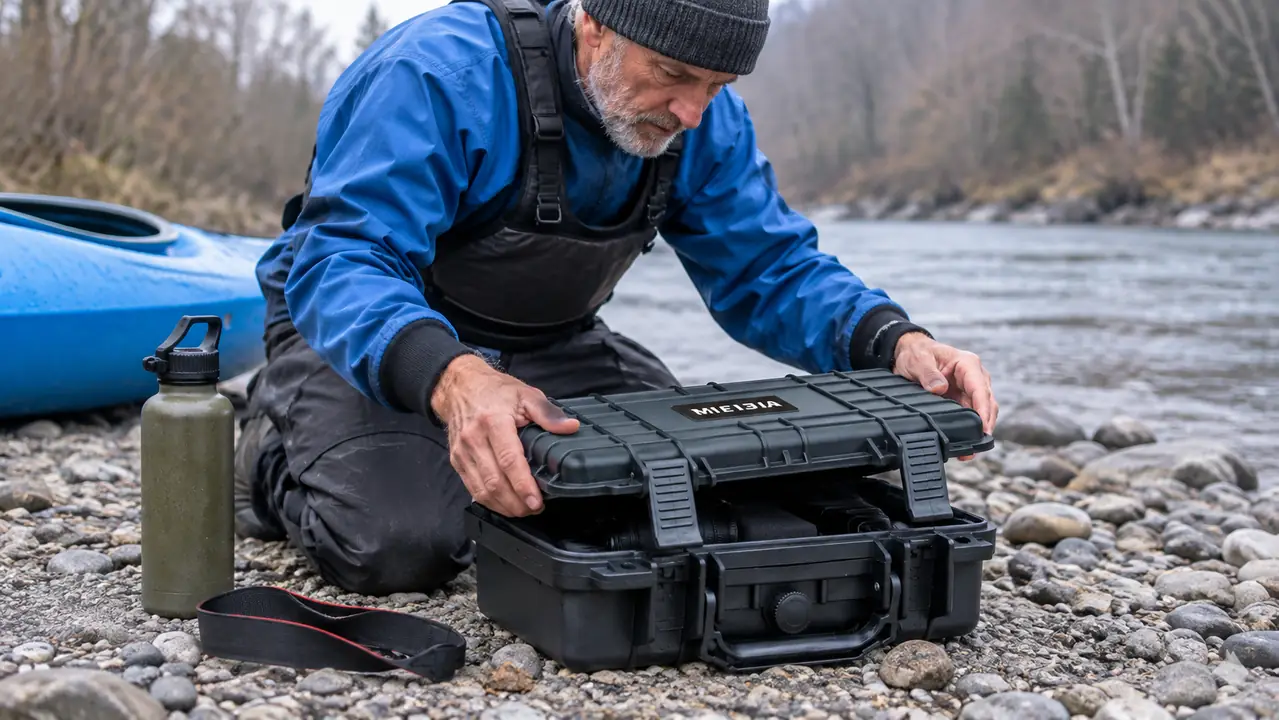
The shell is polyethylene and it is a hard shell in the plain sense of the word. That matters more on a river than people expect. A soft bag protects against water and nothing else. A hard shell takes the point load when somebody drops a boat on the pile, when the case slides under a cooler in the truck bed, when you set your helmet on top of it because both hands are full and the shuttle is leaving.
At 2.1 pounds it feels like a real object without being a burden in a day bag. The exterior the listing gives is 11.65 inches long, 8.74 inches wide and 4.06 inches deep. That is a lunchbox, not a big expedition case, and I mean that as a description rather than a complaint.
It has taken two hits that would have ended a soft bag. The first was my own fault. I set it on the tailgate while I wrestled a boat off the rack, the gate came down when I bumped the lever, and the case went off the back onto packed gravel. A dent on one corner, no crack, seal fine. The second was a cooler sliding forward on a hard brake on the way to the put in. The cooler won that one, but only by a scratch. I have carried soft bags that would have been split open by either.
The Zipper Is the Tradeoff Nobody Mentions
Here is the part the five star reviews tend to skip. The closure on this case is a zipper. Not latches. A zipper. That is not a defect in the design, it is the design, and it changes how you own the thing.
A latch case pulls two hard surfaces together and squeezes a gasket. A zipper case relies on a slider closing a track. The track has teeth, and teeth collect grit. Sand off a gravel bar. Silt out of an eddy. The fine abrasive grit that gets into everything on a river and never quite leaves. Close this case with grit in the seal and you have created the exact small channel water needs. So you check it. Every time. You wipe the track with a thumb, you look at it, you run the slider all the way to the stop. Do that and the case does its job.
I learned this one the ordinary way. Mid June, a sandy takeout below a low water bridge, and I closed the case in a hurry with the truck already running. Four hours later I opened it and found a faint line of silt across the inside of the track and a lens cloth that felt wrong in the hand. Not soaked. Damp at one corner. That is all it takes, and it is exactly the failure I started this review talking about. Since then the wipe is part of the routine the same way the spray skirt goes on before the boat goes in the water.
The maintenance is simple and easy to skip. Rinse the track after a sandy day. Dry it before you store it. Leave the slider open at home so the seal is not compressed in a closet for six months. None of that is difficult. All of it is the sort of thing that separates a case that keeps water out for years from a case that keeps water out until the first careless Saturday.
Three Liters Is Smaller Than You Think
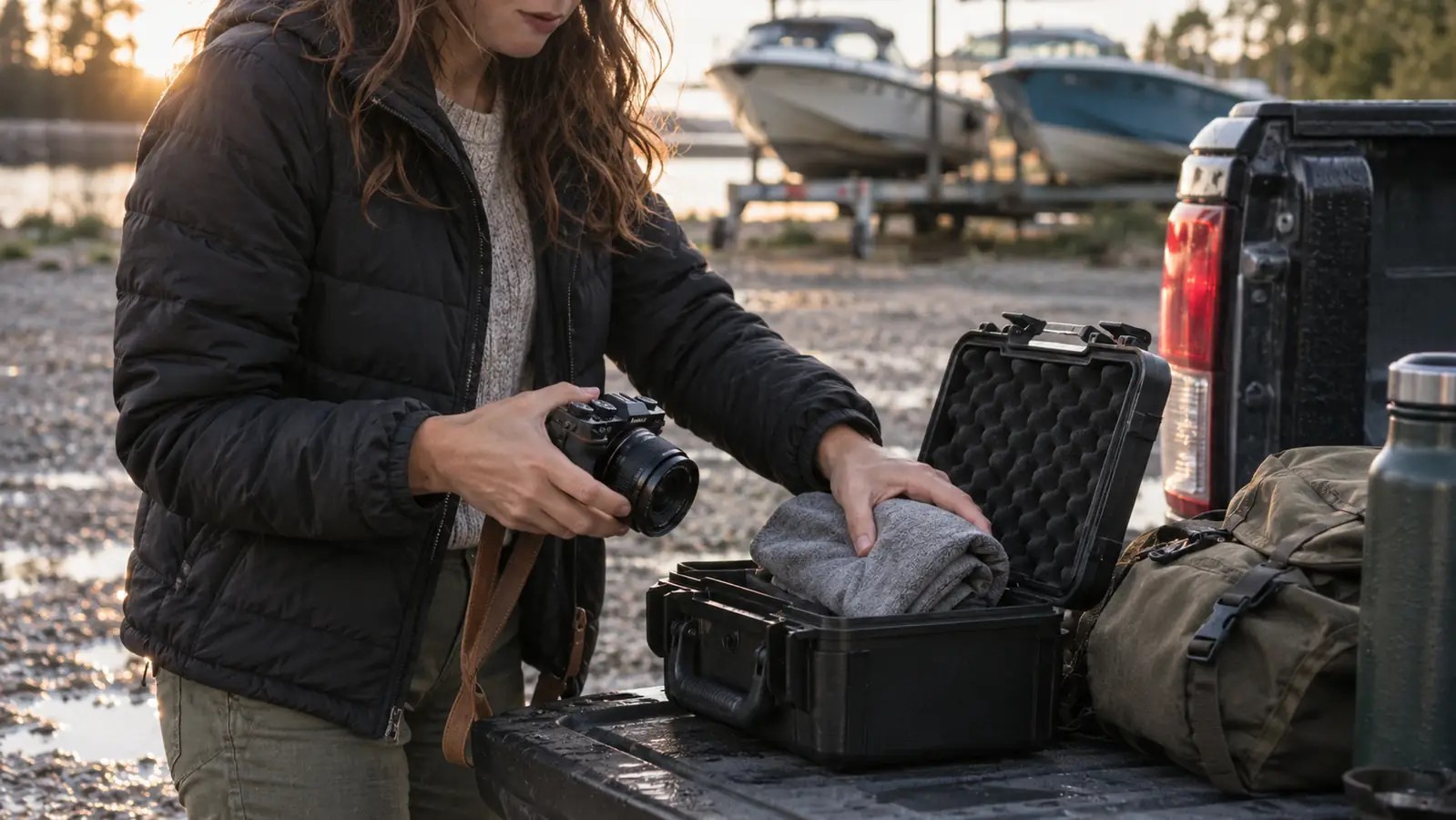
Three liters sounds roomy until you put a camera in it. What fits in mine: a small mirrorless body with a lens mounted, a spare battery, a couple of lens cloths, and a ziplock with a phone and keys. That is the whole load. There is a little air left over and not much else.
What does not fit: a DSLR with two lenses, a full frame body with a zoom mounted, a rain shell, a first aid kit worth carrying, or anything a reasonable person would call a day's kit. If you are shopping for a case to hold your whole camera bag, this is not the one. If you are shopping for a case that keeps the one camera you actually shoot with out of the river, the size is about right.
I tried to make it do more than that in April, and it went badly enough to be worth telling. I had a full frame body with a short zoom, a second lens, a battery grip and a rain shell, and I told myself three liters would stretch. It did not stretch. The lid closed on the grip with a bulge in the middle, which meant the zipper had a straight run of tension instead of a smooth curve, and I spent the whole day opening it up to check. I left the grip and the second lens in the truck after that. The camera I actually shot with all season fit without argument, and the case is better at that job than it is at any other.
One thing worth flagging. The listing gives two different size figures, 11.65 by 8.74 by 4.06 inches and a second one of 11.65 by 8.35 by 3.78 inches. I am not going to tell you which measurement is interior and which is exterior, because I do not know and I would rather say that plainly than guess on your behalf. Measure your camera body. That is the boring advice that prevents a return.
What Waterproof Means Here, and What It Does Not
The listing states a water resistance level of waterproof. There is no depth rating and no submersion time attached to that word, and that is worth understanding before you treat this like a dive box. In a product listing the word usually means the maker expects it to keep water out in ordinary wet conditions. Rain. Paddle spray. A splash over the gunwale. A wet ride home in an open truck bed.
It does not mean you can pin it under a rock in a hydraulic, walk away, and come back for it after lunch. If you swim a rapid wearing the case and it ends up wedged somewhere for ten minutes, the zipper and the shell are being asked to do something nobody promised you they would do. I treat it as weather and splash protection. At that job it has not let me down once.
Temperature is the other question people raise about any sealed hard case. I have opened this one on a hot afternoon after a cold morning on the release schedule, and it opened like any other case. That is the whole of what I can honestly report.
What It Doesn't Do
The only carry hardware the listing describes is a soft grip handle. No lashing point is described, no D ring, no shoulder strap, nothing I would trust to fix it to a boat. On the river that matters. If you want a case that lives on the deck of your solo canoe, this is not that case. Mine rides in the hull, inside a bag, or in the truck.
It also does not organize itself. Three liters of open interior means everything lands in one pile. I keep batteries in a small cloth sack so I am not fishing around in the bottom with numb fingers while the group waits on the eddy line for me to get my act together.
And it does not replace judgment. I say this at the start of every beginner clinic and I will put it in a gear review: no case, no dry bag, no helmet, no boat makes you safe on moving water. Gear buys margin. Training and decisions are what keep you out of the situation where you need the margin in the first place.
Where It Frustrates Me
Two small irritations, and I have had a season to think about whether they are fair. First, the zipper. I understand why the case is built that way and I still do not enjoy checking a seal with cold hands on a windy bank. Second, the interior is one open box. I would happily give up a little capacity for a divider or a lid pocket, and the listing does not describe one.
The handle is worth a word of its own, since it is the one piece of hardware the case actually gives you. It is a soft grip and it is comfortable in a cold, wet hand, which is more than I can say for a hard plastic bail. What it is not is a tie down point. I tried once to pass a short strap through it, just to keep the case from sliding around in the truck bed, and it was clearly the wrong idea. The handle is comfortable and it is not rated for anything but carrying.
Neither of those is a reason to avoid the case. They are reasons to know what you are buying before it shows up.
What I Liked
- Hard polyethylene shell shrugs off drops, stacking and a cooler sliding into it in the truck bed
- Kept a folded paper towel dry through rain, paddle spray and a wet shuttle ride
- 2.1 pounds carries without you noticing it in a day bag
- Three liter footprint tucks under a seat, into a hull bag or behind the truck seat
- Soft grip handle is comfortable in a cold, wet hand
Where It Falls Short
- Zipper seal needs wiping and a full close every time, and grit is what defeats it
- The only carry hardware described is the handle, so lashing it to a boat is not in the cards
- Three liters holds one small camera kit and very little else
- Open interior with no divider or lid pocket described in the listing
- The listing gives two different size figures, which is no help when you are measuring a camera body
The case kept a paper towel dry through a day of rain on the bank and a wet ride home in the truck bed. That is not a laboratory result. It is the test that matters to me.
Who This Is For
This is for the paddler who carries one camera, or a phone and keys, and wants a hard shell around it instead of another soft bag. It suits an open boater or a kayaker who keeps gear in the hull rather than strapped to the deck. It suits the angler or the bird watcher who sets a camera down on wet gravel and wants to stop worrying about it. It suits anyone who has already learned that water finds the small hole and takes its time about it. If that describes you, the MEIJIA case does the job it was built to do, and it does it without drama.
Who Should Skip It
Skip it if you want to strap a case to the deck of a boat, because there is nothing described on this one to strap to. Skip it if your camera kit is bigger than a body and one lens, because three liters will not cover you and you will be annoyed every trip. Skip it if you know yourself well enough to know you will not wipe a zipper track on a gravel bar, because a neglected zipper seal is worse than no case at all: it looks like protection while quietly failing to be any. And skip it if you are heading out on class IV and above for the day. That is a day for a proper dry bag inside a proper boat, not a three liter box in a day pack.
Three liters, 2.1 pounds, one hard shell. Check the current price.
Confirm the interior size against your own camera body before you order, and remember the seal is a zipper, so it asks for a thumb wipe before every close. That is the whole deal with this case.
Amazon Check Today's Price on Amazon →