

Most throw bag reviews get written by somebody who took the bag out of the box, dropped it on the grass, and called it a day. I understand the impulse. A throw bag is not exciting equipment. It rides behind your seat for a whole season and you hope you never have to touch it. But I have pulled mine out for real, on the Ocoee and the Nantahala and a few smaller creeks, with a swimmer in the water and no time to think. That is the only test that tells you anything, so that is what I am writing about.
The Scotty #0793 rescue throw bag has been in my boat for a good while now, and I have handed it to students during rescue practice more times than I can count. I like it. I also think there are things about it you should know before you order one and clip it in expecting it to solve a problem it was never designed to solve. This is an honest review, which means the back half of it is about the ways this bag has annoyed me and the ways I have had to work around it.
The Quick Verdict
A tough, hard-throwing bag with a reflective band I now would not go without. The strap and the rope diameter are where it gives up ground.
Amazon Check Today's Price →One bag that has ridden behind my seat all season
Fifty feet of floating MFP rope in a self-draining bag, with a 3M reflective safety band and an adjustable strap. It is not the fanciest bag on the river. It is the one I keep reaching for.
Amazon Check Today's Price on Amazon →What the Scotty Throw Bag Actually Is
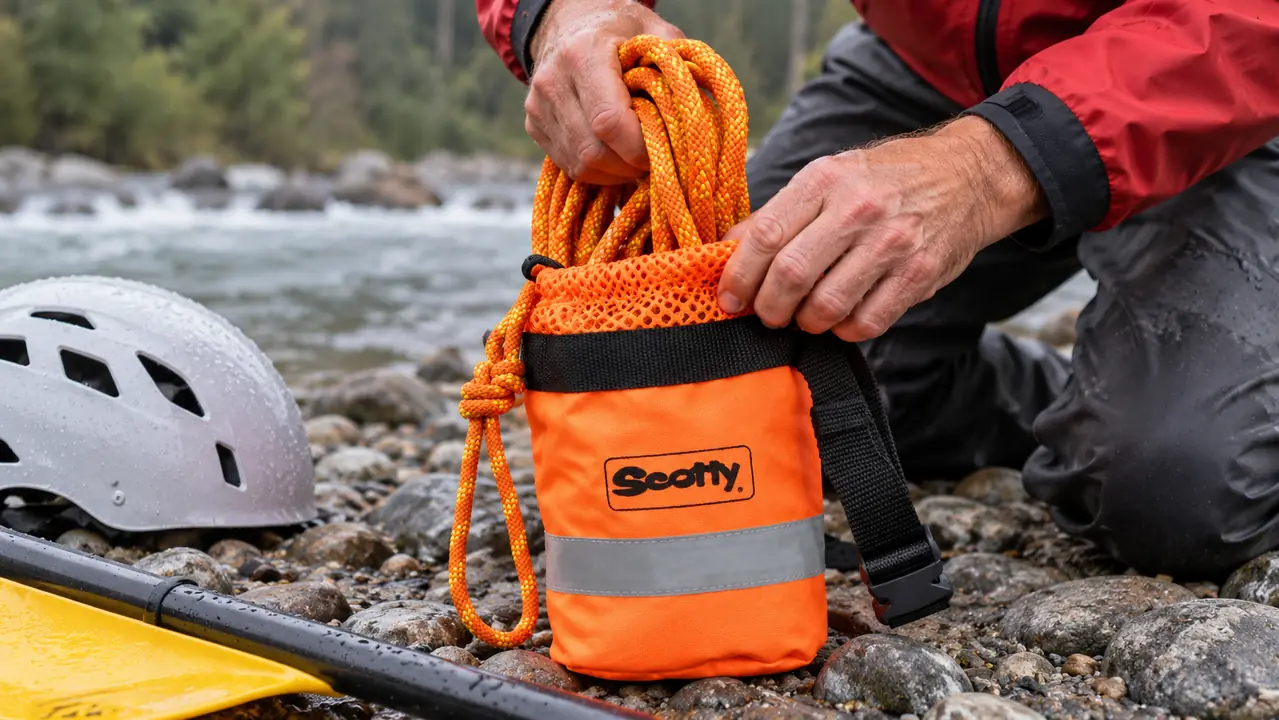
Strip away the packaging and it is three pieces of gear doing three jobs. There is a bag, 50 feet of floating MFP polypropylene rope at 9/32 inch diameter with a 550 pound test, and an adjustable strap. The bag is nylon and polyester with a self-draining bottom, sized at roughly 5 inches by 4 inches, and there is a 3M reflective band sewn around the outside.
That reflective band is the detail I did not expect to care about and now would not buy a bag without. In a shaded gorge the light goes flat fast in the late afternoon, and a bag lying on the bank or hanging off a rescue station is a great deal easier to spot when something on it catches a headlamp or a stray bit of sun. It costs the manufacturer almost nothing and it makes the bag easier to find when somebody is hurrying. Small thing. Real thing.
How I've Used It
I teach weekend beginner clinics in spring and summer, and rescue practice is part of every one of them. That means the bag gets thrown badly, a lot, by people who have never thrown one. It gets dragged through gravel. It gets stepped on. It gets stuffed back into a boat with the rope still wet. After a couple of seasons of that treatment most bags start to show it, and this one has held up better than I expected for what it is.
On the river for real, I have deployed it twice with a swimmer in the water, and both times the bag left my hand clean. Fifty feet is the right length for the rivers I run. Twenty feet is not enough to reach a line across a channel, and seventy feet is more rope than most people can manage in a hurry. Fifty is the practical middle, and the bag is small enough to clip behind a seat without crowding the space where my camera dry bag goes.
I also carry it in my solo canoe on days when I am the only open boat in the group. The strap adjusts enough to go over a thwart or hang off the seat frame, and the bag sits flat instead of rolling around in the bilge.
The honest part about my own use is that the bag has never been the thing that saved anybody. My hands were. The bag is what made the rope available in the half second I had to find it. That distinction is the whole review, and everything below is detail on top of it.
What Nobody Tells You: The Rope Does the Work
Here is the part people skip. The bag is a container. The rope is what saves a swimmer. Floating MFP polypropylene is the right material for a throw bag and it is not a place to save money. It floats, which matters more than most paddlers realize, because a rope that sinks is a rope you are now diving for while somebody is in the current. The 550 pound test rating is honest on this bag, and the braid handles well enough that it does not kink into a bird's nest after the second throw of the day.
What the rating does not tell you is that rope strength has very little to do with whether a rescue works. I have watched students throw a perfect line and then stand there holding it like a leash. A throw bag is not a winch and it is not an anchor system. If you have not practiced the sequence, the bag is a bag. This is the thing I wish every review said out loud, so I am saying it here and I will say it again at the bottom.
The bag does help in one quiet way. Because it holds 50 feet in a package that fits in one hand, you will actually carry it. A coiled rope loose in the bottom of a boat does not get used, because nobody can find the end of it under a dry bag while a swimmer is going downstream. Portability is not a marketing word on this piece of gear. It is the feature that makes the other features reachable.
The rope is also light enough to float and feed smoothly, which means a student can throw it fifteen or twenty feet on their second or third attempt rather than their tenth. I have run that drill with heavier line on other bags and the learning curve is measurably longer. Beginners get discouraged and stop trying. That is a rescue-training problem disguised as a gear detail.
The bag is a container. The rope is what saves a swimmer, and only if your hands already know what to do with it.
Where the Scotty Throw Bag Falls Short
The strap is the weakest part of the design. It is plain adjustable webbing with no swivel, and in cold weather with numb fingers it takes two hands and some patience to get it snug on a seat frame. I have had to re-tighten it after a long shuttle ride more than once. On a warm day it is a non-issue. In March runoff, on a gravel bar, with a group waiting, it is a small irritant you will notice.
The rope is 9/32 inch, about 7 millimeters, and that is on the thin side for pulling with bare hands. In a real rescue with a swimmer loading the line, thinner rope bites into your palm. Gloves help. Wrapping the line around your hip helps more, and you should be doing that anyway. But if you have big hands or you paddle cold water in heavy gloves, you will feel the diameter.
The self-draining bag drains. It does not dry. If you stuff it wet and leave it in the boat, it will still be damp a week later, and damp rope is heavier rope and eventually a rope with a smell. Empty it, hang it, let it dry. That is true of every bag, but the nylon and polyester shell on this one holds moisture a little longer than the simpler single-layer bags I have used.
There is no rope-hand loop at the mouth of the bag, so repacking after a drill takes practice. Beginners finish a throw with loose line outside the bag more often than not, and I end up coaching the coil as much as the throw. A bag with a handle or loop at the opening feeds and stuffs more smoothly under pressure. This one asks more of your hands.
One more thing, and it is the one that matters. The 550 pound figure is a rope rating, not a rescue rating. Nothing about this bag turns it into a haul system, and it should not be used as one without the training to back it up. I have seen people read a number like that and assume the bag can drag a loaded canoe off a rock. It cannot. That is a job for a proper mechanical advantage setup with the right anchor material, and even then only for somebody who has practiced it on a dry gravel bar first.
What I Liked
- Fifty feet of floating MFP rope, enough to reach across a real channel
- Self-draining bag with a 3M reflective band that shows up in low light
- Compact 5 by 4 inch bag sits flat behind a seat or on a thwart
- Survives a season of beginner throws, gravel drags and wet repacking
- Adjustable strap works over a thwart or a seat frame
Where It Falls Short
- Strap takes two hands to adjust when your fingers are cold
- 9/32 inch rope is thin under load with bare hands
- No rope-hand loop at the mouth, so repacking takes practice
- Shell holds moisture overnight if you pack it away wet
The Details That Matter on the River
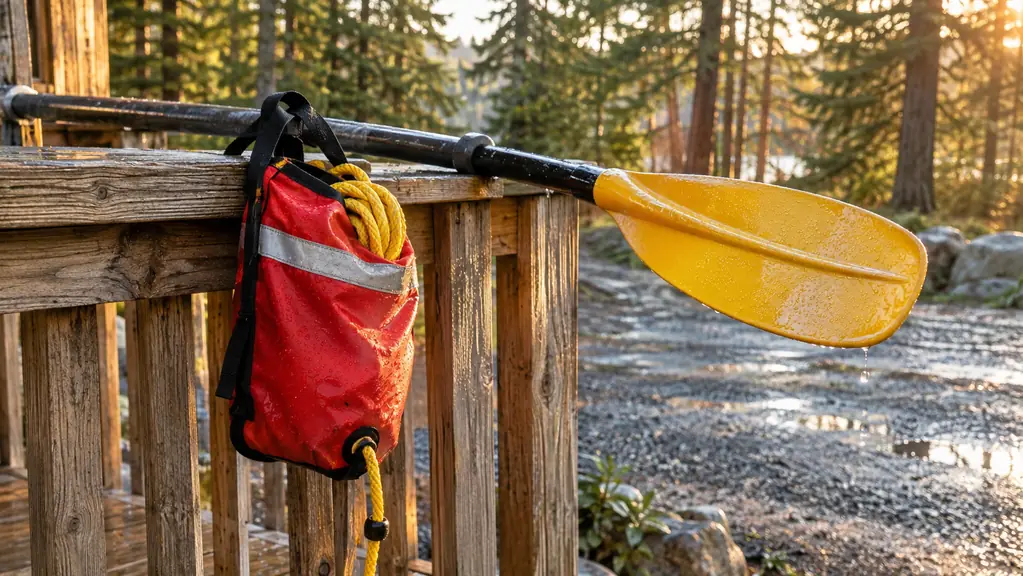
Self-draining matters more than it sounds like it should. A bag that holds water becomes a bag you do not want to carry, and a bag you do not want to carry stays in the boat under a dry bag where you cannot reach it. This one drains through the bottom and sits light again within a minute or two of coming out of the water. That is the difference between gear you use and gear you own.
The size is right for a boat with limited space. Five inches by four is small enough to lash to a seat frame or tuck behind a thwart without fouling your rescue vest. On a clinic day I am carrying a first aid kit, a camera dry bag and a spare layer, and the bag does not fight any of it. On a solo canoe trip with a portage in the middle, that matters more than the spec sheet suggests.
The reflective band earns its place at dusk. On a dam release day the light goes at the same time the water gets pushier, and a group spread out over a quarter mile needs to be able to see each other's gear. A strip of 3M reflective material on the bag is a small addition that helps a leader count heads at the takeout.
Weight is not a factor here. The bag with 50 feet of floating rope in it carries easily in one hand, and it does not change the trim of a canoe or the feel of a kayak behind the seat. For a piece of safety gear that gets left behind when it is heavy, that is the point.
How It Compares to What I Carried Before
My previous bag had a heavier line and a slightly bigger mouth, and it threw like a wet sock until it had been used enough to soften up. The Scotty bag throws well from the first day, and the floating rope is the reason. I gave up a little pulling comfort on the diameter and gained a bag that beginners can actually get out to the swimmer on the first or second attempt. For a teaching bag, that trade is worth making.
What I miss from the other bag is the loop at the mouth and the slightly more substantial strap. Those are the two places where a more expensive bag earns its money, and I will not pretend otherwise. If you are rigging a raft or running harder water where a bag might get loaded hard, spend the extra and get the heavier line and the better hardware. If you are a recreational paddler building a first rescue kit, the Scotty does the fundamental job.
Who This Is For
This bag suits the paddler who wants one throw bag that does the fundamental job well without spending like a guide. Recreational kayakers, packrafters, open boaters on class II and III, and anglers who float rivers where a wading angler could go in. If you are building a rescue kit for the first time, this is a sensible place to start, and 50 feet of floating rope is a length that will serve you on most eastern rivers. Tandem canoes and rafts should carry more than one bag, and one of them should be longer.
Who Should Skip It
Skip it if you are rigging for serious whitewater and you want a rope-hand loop and a thicker line for hauling. Skip it if you paddle in a group where everybody owns the same bag and you want yours to be findable at a glance, because the reflective band only works when a light hits it and a bag on a dark bank is still a bag on a dark bank. And skip it if you are buying gear instead of training. I would rather paddle with somebody carrying a cheap bag and a swiftwater rescue card than somebody carrying the best bag on the market and no practice. Gear does not replace judgment, and no bag on earth will make a bad decision on the river into a good one.
Buy it for the rope and the reflective band, then go practice with it
Fifty feet of floating MFP rope, a self-draining bag, an adjustable strap and a 3M reflective safety band. It has done its job in my boat. The rest is up to your hands.
Amazon Check Today's Price on Amazon →So there it is. The Scotty throw bag is a good bag with two honest flaws and a rope that does exactly what it should. I keep it in my boat, I hand it to students, and I will replace it with the same model when it finally wears out. Just do not buy it and think you are done. Take a rescue course, practice on the flatwater eddy above the put-in, and learn to throw before you need to.