
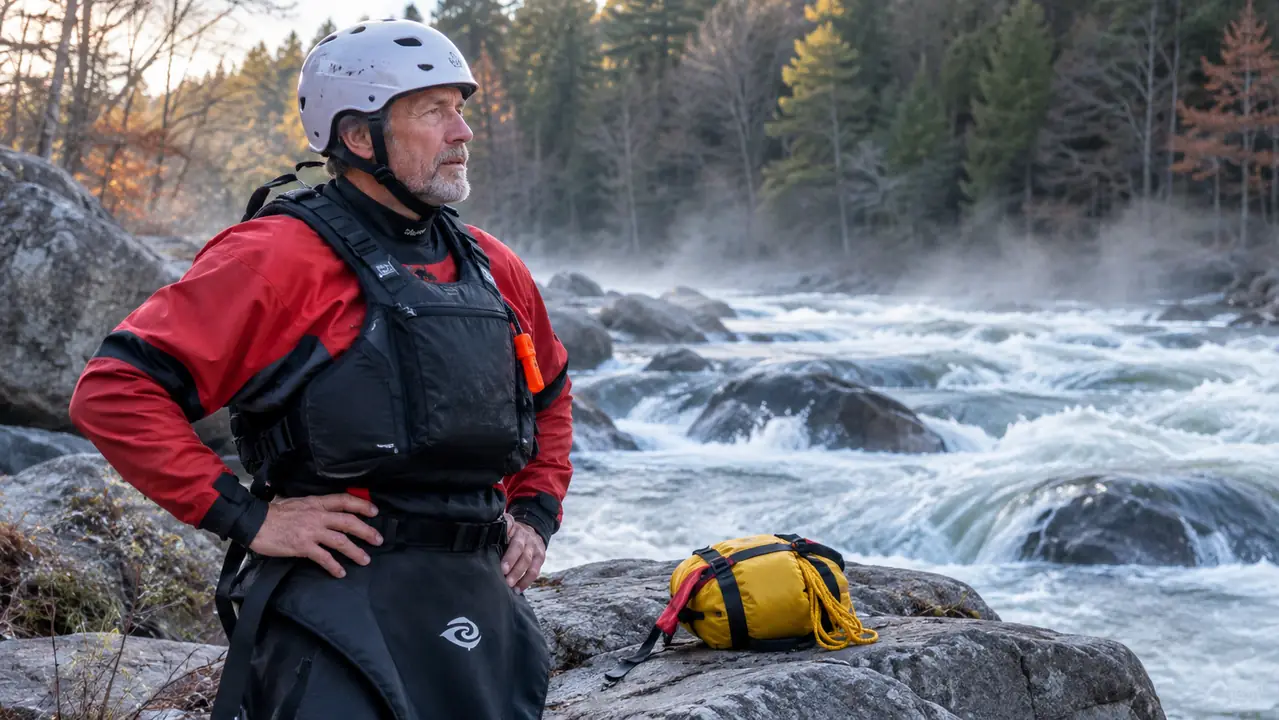
The drill I run at every beginner clinic is the same one my own instructor ran on me thirty years ago. Stand on the bank. Pick a target twenty feet out. Throw the bag. Coil it. Throw it again, until the rope leaves your hand without you thinking about it. I have run that drill with a lot of bags. The one that has lived on my rear deck and in my solo canoe for the past several seasons is the Scotty #0793, a 50-foot rescue throw bag with floating MFP rope. Not because it is fancy. Because it does the two things a throw bag has to do on a cold river. The rope comes out of the bag when you need it, and it floats when it gets there.
I am 61. I live in western North Carolina, near the Ocoee and the Nantahala, and I teach weekend beginner clinics from spring into summer. I paddle a river runner and a solo canoe, mostly class II to IV, and a good share of that is cold water, either spring runoff or a dam release. My gear gets handled by nervous students who have never thrown a bag in their lives. Gear that only works in expert hands is not gear I keep on the boat.
The Quick Verdict
A 50-foot floating-rope bag that comes out clean and drains fast. Buy it for the rope and the bag, not for a belt it does not have.
Amazon Check Today's Price →The Bag That Has Ridden My Deck for Three Seasons
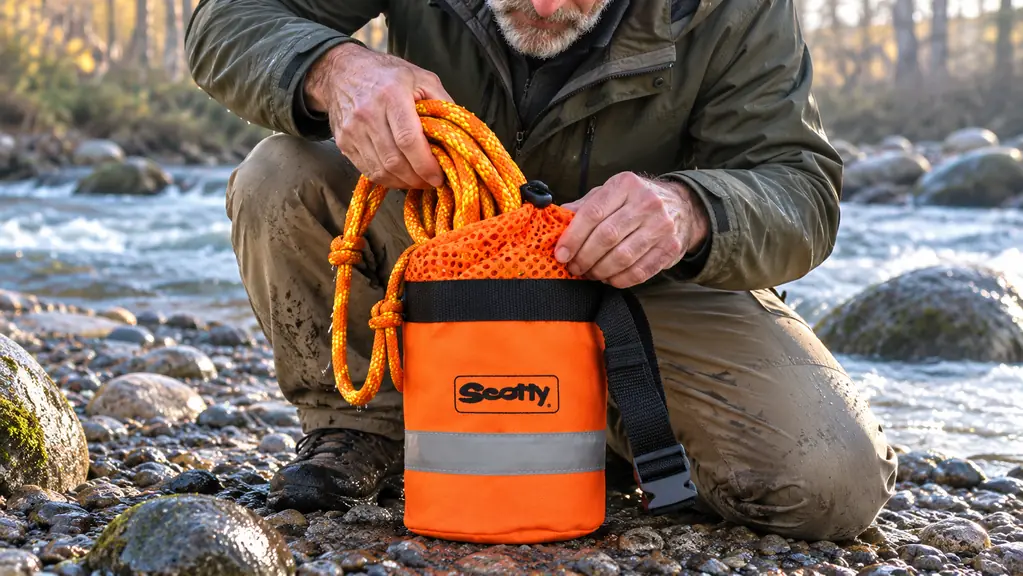
50 feet of floating MFP rope, a self-draining bag, and a reflective band that catches a headlamp at dusk. Check today's price on Amazon.
Amazon Check Today's Price on Amazon →How I've Used It
My use case is not glamorous. The bag rides clipped on the rear deck of the river runner on clinic days, and it sits between the thwart and my knee in the solo canoe when I am running the Nantahala with my wife Karen. On dam release days on the Ocoee, when the water comes up and the eddies get pushy, it is the first thing I check before I get on. I have thrown it in practice far more often than in anger, which is exactly how I would like to keep it. Twice it has gone out for real, once for a swimmer and once for a pinned boat, and both times the rope paid out without a snarl.
What I care about in a bag I am trusting with a real rescue comes down to four questions. Does it come out clean. Does it float. Does it drain. Can I repack it fast with cold hands. The Scotty has been steady on all four. I have also handed it to students on the bank and watched them throw it, and that teaches you more about a bag than your own throws do. Beginners short-arm the throw and try to aim it like a baseball. The rope still pays out, because it is light and comes out without fighting the bag.
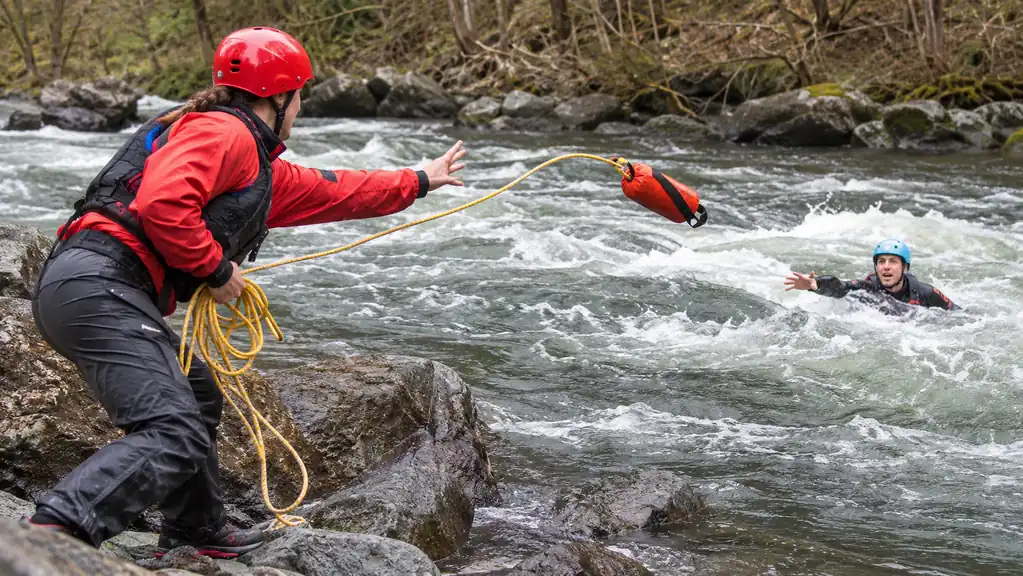
There is one throw I still think about. It was a dam release day, water up and brown, and a young paddler in an open boat dumped in a wave train and came up swimming with the boat pushing him along. I was on a rock below the eddy line, with maybe thirty feet of clear water and a lot of current between us. I threw the bag across the current instead of at him and let the rope swing. He got a hand on it. The rope floated the whole way, which is the only reason it did not get pulled under the ledge and fouled. That is the kind of afternoon that decides whether a bag stays on my deck or goes in the garage.
Maintenance is what you would expect. Rinse it with fresh water after a river day, hang it open to dry, and look the rope over for abrasion and sun damage. Polypropylene does not love years of ultraviolet, and a throw bag that lives on a deck all summer is getting a lot of sun. I retire rope when I see fuzz or flat spots. That is the whole routine, and it takes five minutes at the end of the day.
What 50 Feet of Floating Rope Actually Does
The rope is 9/32 inch braided MFP polypropylene, rated 550 pounds, cut at 50 feet, which is 15 meters by 7 millimeters at 300 kilograms on the metric half of the label. That length is the reason I carry this bag instead of a shorter one. Fifty feet lets me stand on a rock well upstream of a swimmer and swing the bag across the current rather than trying to hit them straight on. It lets me reach a boater who has flushed wide of the eddy I am standing in. Most days I do not need all of it. The day I need it, I need it badly.
Floating rope is not a marketing detail. On moving water, a rope that sinks gets dragged down and across the rocks, and every rock it touches is a place it can foul. A floating rope stays up where you and the swimmer can both see it, and where it can be pulled back for a second throw without being unwrapped from a strainer. That is the practical difference, and it is why I will not carry a sinking rope in a rescue bag no matter how nicely it coils.
The 550 pound rating deserves a word of its own. That is the rope's test number, not a number you plan to load on a real rescue. A person in current puts serious force on a line, and current multiplies weight fast. I treat the rating as a margin, not a target. If a situation asks for more than a throw bag can give, that is a swiftwater rescue problem, and the right move is to call for people with more rope, more gear and more training than you have on you.
The tradeoff of 50 feet is that you have 50 feet to manage. More rope means more to coil, more to stuff, and more chances for a tangle if you pack it in a hurry. I repack mine the same way every single time, and I check it before every clinic. If you stuff a throw bag once in April and pull it out in July, you own a bag full of knots and a false sense of what you have.
Fifty feet of rope is only worth carrying if it leaves the bag in one clean throw. That is a practice problem, not a gear problem.
The Bag Itself: Drainage, Strap, and the Reflective Band
The bag is nylon and polyester with a self-draining design, and it measures 5 inches long by 4 inches wide. It sits flat and small on a deck or in a canoe, and it does not hold water after a wet day, which matters when the bag is going to be jammed back under a bungee and left there. I have owned bags that held a pint of river and dripped on my legs for the rest of the run. This one does not.
The adjustable strap is a carry strap and a way to hang the bag, not a waist belt. I want to be clear about that, because people shop for a throw bag expecting a belt system and then feel cheated when it arrives. If you want a bag mounted on your body, this is not that bag. What it does have is a 3M reflective band on the exterior, and that band is worth more than it sounds. On a late shuttle, or on a river at dusk, a headlamp picks the bag up instantly. When I am hunting for gear on a dark bank, anything reflective saves me time I would rather spend on the water.
The bag carries a limited warranty, and the exterior is a bright orange nylon and polyester. I mention the color only because the point is visibility, not style. On a riverbank, gear you can find is gear you actually use, and gear you cannot find is weight in your boat. That is the whole argument for a bag that shows up against gravel and wet rock.
What I Liked
- 50 feet of 9/32 inch floating MFP rope, rated 550 pounds, gives real reach from a bank or an eddy
- Self-draining nylon and polyester bag does not hold water after a wet day on the river
- 3M reflective band makes the bag easy to find with a headlamp at dusk or on a late shuttle
- Adjustable strap carries well and hangs off a pack or a boat cleanly
- Rope pays out without snarls, including when nervous beginners do the throwing
- Small footprint at 5 by 4 inches, so it stows on a deck without crowding the cockpit
Where It Falls Short
- The strap is a carry strap, not a waist belt, so the bag is not body-mounted
- 9/32 inch rope is thin in cold, gloved hands and takes practice to handle and hold
- 50 feet is more rope than some paddlers want to coil and repack in a small boat
- It is a bag and a rope. It does not replace a rescue course, a rescue vest or practice
Where It Falls Short on the River
The thin rope is my main complaint, and it is a complaint about every rope this diameter, not just this one. At 9/32 inch it is harder to grip with numb hands and gloves, and it is harder to keep a wrap on under load. Thicker rope is easier to handle and heavier to carry, and every bag maker picks a point on that line. Scotty picked light and long. That is the right pick for a bag that mostly gets thrown, and the wrong pick if you want a rope you can haul on comfortably with gloves on in February.
The other thing I notice is that 50 feet changes how you pack. In a solo canoe there is plenty of room. In a tight boat packed with flotation, a full 50-foot bag takes up real space, and I have watched students try to cram one into a spot that wanted a 40-foot bag. That is not a defect in the bag. It is a decision you make when you buy it, and it is worth making honestly.
And the last point, which is not about this bag at all. A throw bag is a tool, and a tool without training is a coil of rope with a nice handle on it. I have watched people buy a rescue bag and consider the problem solved. It is not solved. It is started. The bag is one line item on a list that begins with a rescue course and ends with a hundred practice throws on a bank.
Who This Is For
This is a good fit for paddlers who want a dedicated rescue bag on the boat, instructors who hand gear to students, canoeists with room for a full 50-foot bag, and anyone running cold water where a swimmer goes from cold to useless in a few minutes. It is also a sensible bag for a raft guide's dry stash or for a bank angler who spends time around moving water. If you want one bag that reaches, floats, drains and can be found in the dark, this is that bag.
One more use I did not expect. In the canoe, on flat stretches, I have used the bag as a throw line for a pinned dry bag, and once for a camera bag that went in when I was set up for birds on the bank. Fifty feet of floating line is useful for more than swimmers, and it does not mind being used for small jobs.
Who Should Skip It
Skip it if you want a belt-mounted bag that rides on your body, because this is not one. Skip it if you paddle a tight creeks boat where 40 feet is plenty and space is short. Skip it if you are not going to practice with it, because the bag will not do the work for you, and an unpracticed throw is the most common failure I see on a bank. And skip it if you are shopping for a piece of gear that makes you safe. Nothing on the market does that, and I would be lying to you if I said otherwise.
What I Tell Students at the Put-In
Every clinic starts the same way. I hold up my bag and tell them what it has cost me in practice hours, not dollars, because the practice hours are the part that matters. Then I tell them that the best throw bag in the world is a bag you have thrown a hundred times, and the worst is a bag you bought and never opened. Take a swiftwater rescue course. Practice on the bank before you put on. Learn to coil and repack with cold hands and a glove on. The Scotty has been a reliable piece of that routine for me, and it will be for you if you treat it as one tool among several rather than a substitute for judgment.
Buy the Rope, Then Earn the Throw
50 feet of floating MFP rope in a self-draining bag with a reflective band. Practice with it before the day you need it. Check today's price on Amazon.
Amazon Check Today's Price on Amazon →