

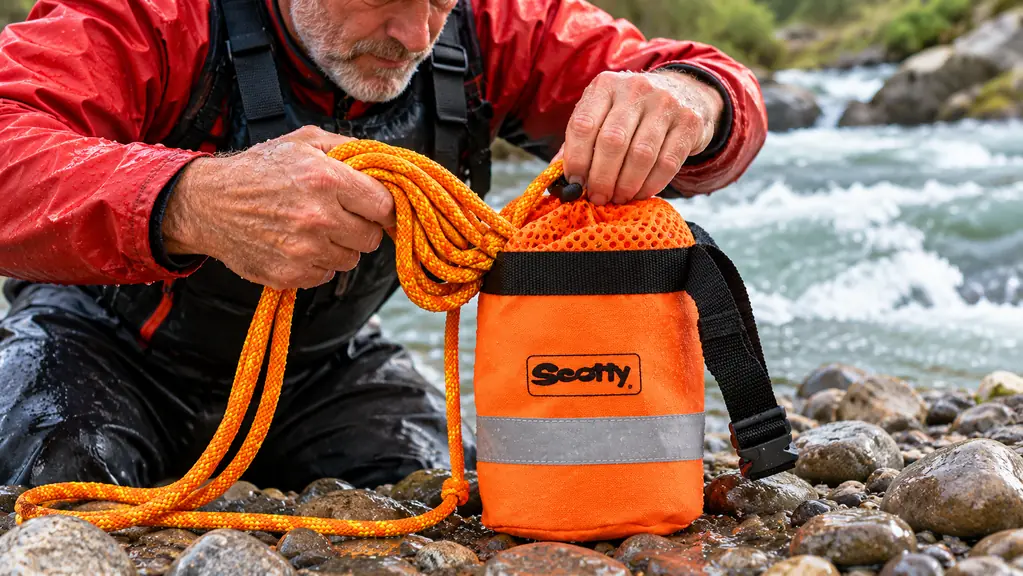
Twenty-eight years of teaching rescue drills on the Ocoee and the Nantahala, and the question from beginners has not changed one bit: which throw bag goes on the vest? For most of that time my answer has been the Scotty #0793 Rescue Throw Bag. Fifty feet of 9/32 inch braided MFP polypropylene, floating, rated to 550 pounds, in a self-draining nylon and polyester bag with an adjustable strap and a 3M reflective band stitched down the outside. Nothing on it is fancy. All of it works.
The other bag that turns up at clinics is the NRS Compact Rescue Throw Bag. Compact is the honest word for it. It packs smaller and rides flatter against a vest, and on a narrow creek with brush leaning out over the water, that is not a small thing. So this is not a piece about one bag being junk. It is about which one belongs on your vest, given the water you actually paddle.
| Scotty #0793 | NRS Compact | |
|---|---|---|
| Bag footprint | 5 inch by 4 inch sack, room for the full 50 feet | Compact shell that sits flatter against a vest |
| Riding on a rescue belt | Adjustable strap works, but the sack is fuller | Slimmer profile with less to snag on brush |
| Rope spec | 50 feet of 9/32 inch braided MFP, 550 pound test, floating | Floating rescue line included, check the current length before you buy |
| Cold-hand grip | 9/32 inch braid fills a numb palm | Slimmer line, friendlier to small hands |
| Visibility on the bank | 3M reflective safety band stitched to the outside | No comparable reflective band |
| Drain and repack | Self-draining nylon and polyester, stuffs one-handed | Repacks fast, with a snugger stuff |
| Cost tier | The lower-cost of the two | Costs more |
| Best for | Kayak and canoe paddlers who want the most rope and a bag they can find at dusk | Small-framed paddlers and anyone short on vest real estate |
Where Scotty Wins
Start with the rope, because on a throw bag the rope is the rescue. The Scotty carries 50 feet of 9/32 inch braided MFP polypropylene, floating, with a 550 pound test rating. Nine thirty-seconds is a real handful of line. When your fingers are cold and slow and you are trying to get a second coil off the bank, a braid that fills your palm is worth more than a braid that slices across it. I have watched a nervous student fumble a thin line in March runoff, and I have watched that same student hang onto the Scotty braid ten minutes later. Same hands. Different rope.
Then there is the bag. Self-draining nylon and polyester means you are not carrying a quart of river home with you, and the sack goes back into shape with one hand while the other hand is busy. The 3M reflective safety band is a feature I did not think I needed until the evening I spent ten minutes hunting for a bag on a gravel bar at last light. A throw bag you cannot find is a throw bag you do not have. The adjustable strap takes it onto a belt or over a shoulder, and the 5 inch by 4 inch sack drops behind the seat of my river runner or into the bow of my solo canoe without an argument.
There is one more thing, and it matters more than shoppers like to admit. This is the bag people actually carry. It is the one I see on beginner vests at every clinic, in club boats, in the loaner pile. Gear that gets bought and worn beats gear that gets admired on a shelf.
Where NRS Wins
I will say plainly what the compact shape buys you. On a tight line of class III with low branches and a steep bank, a bag that sits flat against the vest does not catch on anything while you are scrambling down to the water. The NRS Compact is built around that reality. It disappears on your vest in a way the Scotty does not, and a bag that disappears is a bag you forget you are wearing, which means you wear it on the days you would otherwise leave it in the truck.
It is also the easier fit for a small-framed paddler. Karen paddles class II and III with me and runs shuttle on the harder days, and she has said more than once that a compact bag sits better on her vest than a fuller sack does. If the choice comes down to a rescue bag that gets carried all day versus one that gets left behind, the compact wins on the merits. That is a real concession, not a courtesy.
One more. If you plan to clip your one bag to a rescue belt rather than a PFD pocket, the slimmer shell is the easier carry. Different job, different bag, and I am not going to pretend otherwise.
Fifty Feet, a Reflective Band, and a Bag That Repacks One-Handed
The Scotty #0793 is the bag I clip on for clinics. Fifty feet of floating 9/32 inch braided MFP rated to 550 pounds, a self-draining sack, an adjustable strap and a 3M reflective band. It is the one I hand to beginners.
Amazon Check Today's Price on Amazon →What Fifty Feet of 9/32 MFP Actually Buys You
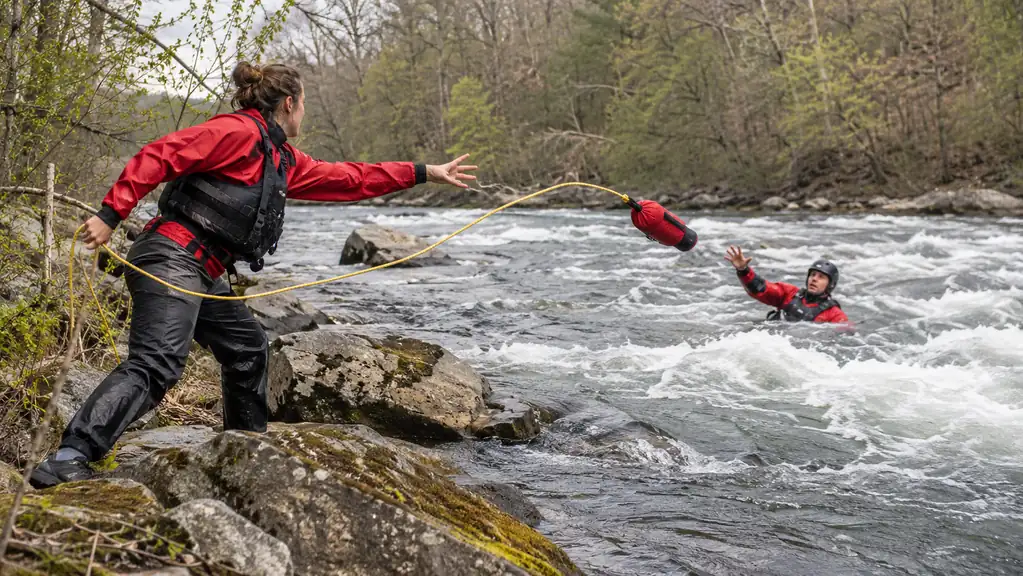
Numbers printed on a bag are easy to write and hard to feel, so let me put this in river terms. Fifty feet is the working distance that covers a swimmer getting pushed down a class II or III shoot while you are standing on the bank above them. It is not fifty feet of accuracy. On a good throw you will use maybe thirty of it. The other twenty is for the throws that are not good, and for the day the swimmer is further out than you judged.
The 550 pound test figure is a rope strength number. It is not a tow rating, and it is not a promise that the bag will hold a pinned boat in a hydraulic. What holds a swimmer is the throw, the anchor you have in your feet, and the fact that you have practiced. Gear does not replace training and judgment. I say that at the top of every clinic and I will say it here: a throw bag lets a trained paddler act faster. It does not make an untrained paddler trained.
Braided MFP polypropylene floats, and that detail matters more than most people think. A rope that sinks is a rope that finds the one submerged rock you cannot see and wraps itself around it. Floating line stays where you can see it and where a swimmer can grab it. Braided rather than twisted also means it handles better in the hand and does not turn into a bird nest every time you stuff it back into the bag.
Fifty feet is not fifty feet of accuracy. On a good throw you use thirty. The other twenty is for the throws that are not good.
How the Two Bags Behave in a Cold-Water Clinic
Most of my clinics run in spring, on cold runoff, with people who have never thrown a rescue line at a human being. That is the real test, not a parking lot. I put one student on the bank and another in the eddy as the swimmer, and we throw until the bag goes where it is supposed to. What I watch is how fast the thing comes back to ready after each throw.
The Scotty stuffs fast. Shake it out, feed the line in, pull the drawstring, back on the belt. The self-draining bag means you are not fighting a wet sock of nylon that will not open. That speed matters, because a setup that takes ninety seconds to reset is a setup that gets skipped on the second drill.
The NRS Compact stuffs fast as well, and I want to be fair about that. Where it gets harder in a clinic is rope volume in a beginner's hands. A compact bag holds its line tightly, and a tight coil is more to manage on the bank for somebody who has thrown a rope four times in their life. That is not a defect. It is a trade.
I also shoot photographs from the boat and the bank, so I notice how wet gear travels. Both bags drain well enough to ride in a day hatch next to a camera body without soaking it. That is not the reason to buy either one. It is a detail I care about.
The Small Details That Decide It on the Water
The 3M reflective band on the Scotty reads like marketing until you need it. Set a bag down on a gravel bar, walk fifty yards to scout, come back at dusk, and the difference between a band that catches a headlamp and one that does not is the difference between carrying your rescue gear home and buying another one. I have done both.
The adjustable strap is the other quiet one. It goes around a belt or over a shoulder, and it stays put when you are climbing over a log. I have owned straps that loosened under load and straps that would not adjust at all with cold hands. This one does neither, which is the highest praise I give a strap.
On the NRS side, the compact shell is well finished and the closure works with gloves on. I have not seen one fail. If you are choosing between these two on build quality alone, you are going to stand there a while, because both come from companies that have been at this for decades.
Who Should Skip Both
If you paddle flat ponds and never run moving water, a throw bag is a good thing to own and a low priority. Buy one, learn to throw it in a park, and put your attention into a PFD that actually fits first. A rescue bag on a vest is not worth much if the vest does not stay on when you swim.
And if you are looking at a throw bag as a substitute for a swiftwater rescue course, skip the bag and take the course. I mean that without any hedging. The bag is the easy part. The skill and the judgment are the parts that save people, and neither one comes in the sack.
Who Should Buy Which
Buy the Scotty #0793 if you want the most rope and the most visible bag of the two, if you paddle a kayak or a solo canoe where a 5 by 4 inch sack stows without a fight, and if you are outfitting a family or a club where you are buying three or four bags at once. It is the bag I have handed to more beginners than any other piece of rescue gear I own, and I have never had one come back with a problem.
Buy the NRS Compact if vest real estate is your limiting factor, if you are small-framed, or if you are the paddler who has been leaving the throw bag in the truck because it feels bulky. A compact bag that rides on your vest all day is worth more than a bigger bag sitting on the bank. And if you already carry a full-size bag, the compact makes a sensible second bag for a rescue belt.
Whichever way you go, put your name on it in marker, throw it twenty times before you need it, and get some instruction. The bag is a tool. It is not the rescue, and it is not a substitute for knowing what to do with it.
The Bag That Lives Behind My Seat, and the One I Hand to Students
Fifty feet of floating 9/32 inch braided MFP rated to 550 pounds, a self-draining bag, an adjustable strap and a 3M reflective band. If you want the bag I keep in the boat, this is the one.
Amazon Check Today's Price on Amazon →