

The Vihir helmet arrived in a plain box in March, and I did what I do with anything that is supposed to stay on my head in a hole: put it on, shook my head side to side, then tried to think of the fastest way to knock it off. That is not a knock on Vihir. That is just the test. Five months and somewhere north of forty river days later, most of them on the Nantahala and a handful on the Ocoee, I have a much clearer picture of what this helmet does well, and one big thing it will not do for you at all.
Here is the short version, and I will say it plainly because I would rather talk you out of a bad purchase than lose a student to one. The Vihir Adult Water Sports Adjustable Helmet is a well-made general water sports helmet with ear coverage. It works fine for class II, easy class III, flatwater, lakes, and casual surf. It is not a whitewater-specific helmet. If you are regularly running class IV or harder, buy something built for that instead. Everything below is the detail behind that one sentence.
The Quick Verdict
Comfortable, easy to forget you are wearing, and genuinely useful in cold water. Not a whitewater-specific helmet, and the single large size leaves some heads out.
Amazon Check Today's Price →Before anything else, put a tape measure around your head
This helmet comes in one size, L, cut for 59 to 63 cm. Fit decides everything with a helmet, so measure above the ears before you order anything.
Amazon Check Today's Price on Amazon →How I Actually Put It to Work
I teach weekend beginner clinics in spring and summer, which means I spend more time in a helmet standing in the shallows than most people spend paddling. A clinic day for me is four or five hours with the helmet on and off constantly: hauling boats, demonstrating a wet exit, rolling in the eddy, then standing on the bank talking with it still on my head because I forgot I was wearing it. That last part is a better review than anything I can write. A helmet that announces itself every thirty seconds does not get forgotten.
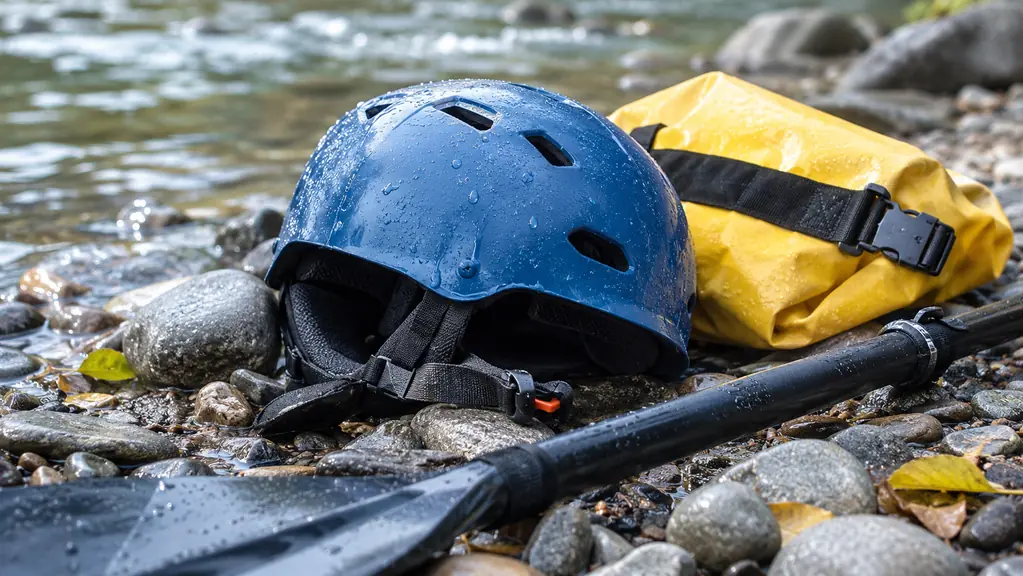
The weight is listed at 420 grams, about the same as a full water bottle, and on the water it reads as unremarkable. Not weightless, not heavy. I weighed it on the kitchen scale the morning it arrived, straight out of the box with no packaging, and got 424 grams, which is close enough to the listed number that I stopped wondering about it. The listed dimensions are 10 by 8 by 8 inches, and it drops into the same dry bag pocket I use for a spare layer on canoe days, which is where it lives when it is not on my head. I noticed the weight for the first ten minutes of the first day and have not thought about it since. The ABS shell over an expanded polystyrene liner is the standard sandwich for this class of helmet, and the 11 vents are placed so the front channels catch air when you are moving. When you stop, they stop. That is how vents work, and anyone who tells you different is selling something.
I also paddle a solo canoe, and the helmet has been on my head for every one of those days. Kneeling in a canoe puts your head lower and closer to gunwales and rocks than sitting in a kayak does, and I have clipped the shell on a gunwale more than once getting in. It scuffed. Nothing cracked, nothing loosened, and the ear flaps stayed where they were put.
Forty-odd river days, a full spring of cold runoff, one scuff from my own canoe gunwale. The shell has never shifted when it mattered.

What the Ears Are Actually For
The ear coverage is the reason most people click on this helmet, and the listing describes it as protecting your ears from scratches without getting in the way of hearing. That matches what I found. Cold spring runoff off a dam release is the test case. Water in the high thirties and low forties will give you an ear ache that ends your day faster than tired arms will, and the flaps take the edge off the wind and the first shock of a roll. They do not keep water out. Nothing short of a swim cap does, and a swim cap under a helmet is a conversation for another day.
The morning I keep coming back to was a release in late March, air around 41 degrees, water colder than that, and a wind coming straight up the valley at the put-in. Half the group had bare ears and half did not. By the second eddy the bare-eared half were holding their hoods down over their heads with one hand and paddling with the other, which is a bad way to run a rapid and a worse way to teach one. The flaps did not make anybody warm. They made the morning tolerable, and on a cold morning tolerable is the difference between a full run and a short one.
The hearing part matters more than shoppers think. In a clinic I need to hear a whistle, a shout from an eddy, and the low rumble of water changing upstream. I have worn helmets that muffled everything into a cottony blur, and that is its own hazard. The Vihir does not do that. Voices come through clear, and I have run a whole safety briefing with students twenty feet away without asking anyone to repeat themselves.
What nobody mentions about ear flaps is that they hold water. Roll, come up, and you get a small slosh against your ear for a few seconds. It is not a problem. It is just there, and if you have never worn a helmet with ear coverage you will notice it the first time and then never again. They are also warm. In July, on a slow flat stretch with the sun overhead, you will feel it. I take mine off at lunch on hot days and I do not apologize for it.
The Fit Question Nobody Asks Until It Is Cold
This helmet comes in one size, L, and the listing gives the range as 59 to 63 cm. That is a wide window and the adjustment covers a lot of ground inside it, but a wide window is not the same as a universal fit. If you do not own a soft tape, run a string around your head an inch above the eyebrows, pinch where it meets, and lay the string against a ruler. Do it twice. I have had students measure 61 in the shop and 58 in the parking lot an hour later because the first pass went around the ears and over a knit hat. Same head, three centimeters of error, and three centimeters is the whole difference between this helmet fitting and not fitting at all.
My head measures 60 cm and I landed in the middle of the range with room to spare in both directions. If you measure 57 cm, no amount of adjusting is going to make a large shell sit right, and the listing is honest about why that matters: a poorly fitting helmet can be as dangerous as no helmet at all. That is the truest line in the whole product description.
Here is the part that does not show up in reviews written on day one. The fit you dial in in a warm room in June is not the fit you get in March with a hood, cold hands, and a nose running. Getting the strap right with numb fingers is the slow part of any helmet, and this one is no different. If you paddle cold water, put the helmet on before you put your gloves on. That sounds like nothing. Do it wrong once at a put-in with a group waiting on you and you will remember it.
The other fit question is what happens on impact. A helmet that shifts when you slap it will shift when you hit a rock. Before you ever get on the water, put it on, fasten it, and have someone push your head firmly in four directions. It should move with your scalp, not slide around it. If it slides, you are not done adjusting. This applies to a Vihir helmet, to a whitewater-specific helmet, and to anything else you put on your head.
What Held Up and What Did Not
The honest answer is that nothing failed. After a full spring of cold runoff and a summer of clinics, the shell has no cracks, the liner is intact, the ear flaps are still attached at both ends, and the vents have not collected any strange souvenirs. The one-year warranty is listed on the product, and I have not had to use it, which is the only useful thing I can say about a warranty.
What did show wear is the soft goods. The strap edges fuzz after a season of being dunked in river water and left in the bed of a pickup, and the padding inside has taken on the smell of every river I have paddled. That is not a Vihir problem. That is a river problem, and the fix is a rinse in fresh water and a hang in the shade, which I do about half as often as I should. I rinsed it properly once in June, hung it on the porch rail out of the sun, and let it dry overnight, and it came back smelling like nothing at all. The time I skipped the rinse and threw it straight back in the truck bed, I paid for that decision for a week. Watch the strap ends first, because they go before anything else. If a webbing end starts to fray, do not saw it off with a knife. Melt the tip with a lighter and press it flat while it is still warm, or it will keep unraveling one thread at a time all season.
My one real complaint over five months is that the ear flaps are not removable. On a hot July afternoon, on a slow stretch where nobody is going to hit anything, I would rather have the airflow than the ear coverage. Having both or neither is a limitation, not a defect, and the price of that limitation is a warm head for a couple of hours a year.
Where It Falls Short
I have to be blunt about the certification question, because it is the thing that should drive your decision. The Vihir helmet is described as a general water sports helmet. Neither the title nor the listing makes a claim to a paddling certification standard, and I am not going to invent one on their behalf. That is not a scandal. It is a category difference, and it decides who should own this helmet.
Whitewater-specific helmets are built and tested for the kind of impact a kayaker takes in a shallow, rock-bottomed rapid. If you are running class IV or harder, or you are a beginner who is going to be upside down in shallow rock gardens a lot, look at a whitewater-specific helmet. Buy the Vihir for class II and easy class III, for lakes, for flatwater, for surf, for a canoe on a slow river, and for the guest who borrows a boat twice a year. Those are all real uses and this helmet serves them well.
The liner is expanded polystyrene, the same material as a bike helmet. It works by crushing, once. Any hard hit retires it, no matter how fine the shell looks afterward. Write the date on the inside with a marker so you know how old it is, and replace it after a real impact. That is not a flaw in the Vihir, it is how the material behaves, but nobody tells new paddlers and then they keep a five-year-old helmet with a cracked liner on their head because it still looks good on the shelf.
The 420 gram shell is not the lightest thing on the water either, and ABS is a durable choice more than a featherweight one. For a three-hour clinic block I do not care. If you are racing or covering long flatwater distances, you will feel the difference against a lighter shell. And the 11 vents help when you are moving. Sitting still on a bank in August, in a helmet with ear coverage, is warm. That is the trade you make for the ears, and it is worth making, but you should know you are making it.
What I Liked
- Ear coverage that protects against cold water and scrapes without blocking voices or whistles
- Light enough at 420 grams to forget about during a four-hour clinic block
- 11 vents with front channels that move air while you are paddling
- ABS shell over an expanded polystyrene liner, the standard build for this class
- Adjustment range covers 59 to 63 cm, which is a lot of adult heads
- One-year warranty listed on the product
Where It Falls Short
- No claim to a paddling certification standard, so it is not a class IV helmet
- One size only, so smaller heads will not get a safe fit no matter the adjustment
- Expanded polystyrene liner is single impact and must be replaced after a hard hit
- Ear flaps hold water after a roll and get warm in summer
- Not removable ear coverage, so you cannot run it open on hot days
- 420 grams is not the lightest shell if you race or cover long flatwater miles
Who This Is For
This helmet fits the paddler who spends most of their time on class II and easy class III, who paddles cold water and wants their ears covered, who wants one helmet that can go from a kayak to a canoe to a lake to a surf session without a second purchase, and who would rather put their budget into instruction than into the lightest shell on the shelf. That last point is not a joke. I would rather see a student in a Vihir helmet with four hours of coaching behind them than in a top-shelf helmet they bought instead of the class.
It also fits the household that keeps a spare helmet for visiting family and friends. The wide adjustment range means one shell covers a teenager and a grown adult, and the ear coverage means the person who is already nervous about cold water is a little less nervous. Mine has been on three different heads this summer and it did not complain about any of them.
Who Should Skip It
Skip it if you run class IV or harder, if you are a beginner who will be upside down in shallow rock gardens, if your head measures well under 59 cm, or if you need a helmet that carries a paddling certification for a club, a race, or a guided trip that requires one. All four of those are ordinary situations and none of them are criticisms of the helmet. They are just the boundary line, and the boundary line is the most useful thing a review can hand you.
And skip it if you were hoping a helmet would do some of the work for you. It will not. No helmet will. What keeps you off the rocks is the line you chose, the scout you did, the roll you practiced, and the friend who ran shuttle. The Vihir covers your head for the water most people actually paddle, and that is the whole claim. Get the fit right, get some instruction, and get on the river.
Measure your head, then decide. It takes five minutes.
For class II and III paddling, cold water, and covered ears, the Vihir helmet does the job. Check the size range against a tape measure and read the current listing before you commit.
Amazon Check Today's Price on Amazon →